

Calcutta HC Confirms Penalty U/S 129 | Biz Flow Kit
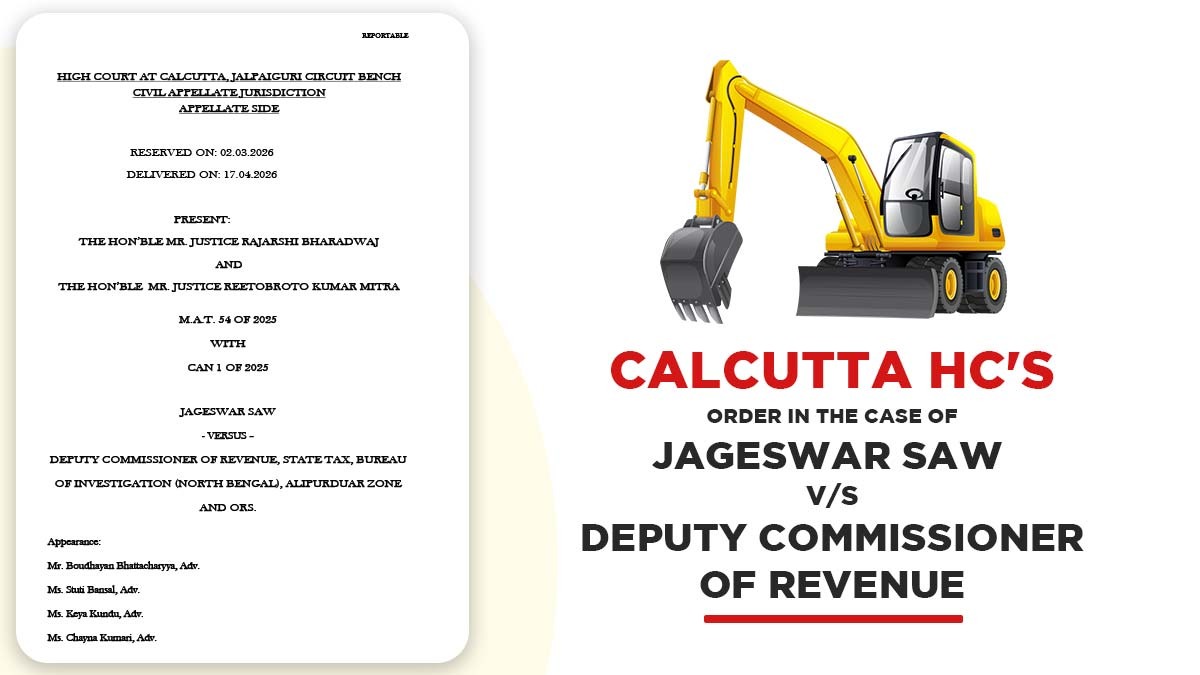
The appellant, a sole proprietor, is involved in leasing construction machinery and arranging transportation of a hydraulic excavator from Jharkhand to Meghalaya through West Bengal.
At the time of transit, the vehicle was intercepted by State GST authorities in West Bengal. It was found on inspection that the appellant, even after being a registered taxpayer, had declared himself as an “Unregistered Person (URP)” in the e-way bill.
Thereafter, the delivery challan carrying the goods was signed by the driver and not by an authorised signatory of the appellant. The authorities considered the same as a breach u/s 129 of the GST Act and detained the goods.
The adjudicating authority and the appellate authority initiated and confirmed the penalty proceedings. The writ petition contesting the same was dismissed by the Single Judge, leading to the present appeal.
The issue- Whether GST authorities of a transit state (West Bengal) had jurisdiction to detain goods only passing through; misdeclaration as URP and improper documentation justified penalty u/s 129.
Read Also: What is GST E-Way Bill & How To Generate Via Online or SMS in Your State?
Ruling of High Court- The High Court dismissed the appeal and upheld the penalty. The Court held that GST officers in West Bengal were authorised to intercept and detain goods in transit due to the principle of cross-empowerment under GST laws.
The claim that the State was only a transport corridor was not accepted. The court, based on the merits, discovered that declaring a registered person as an unregistered person in the GST e-way bill was an incorrect declaration. Whether intentional or not, the issue of mens rea is irrelevant in tax evasion cases.
The Court also concluded that the driver could not be considered an authorised signatory for the appellant. As a result, the delivery challan was deemed defective and did not meet statutory requirements.
Important: How GST Software Helps Transport & Logistics Businesses
The Court noted that such discrepancies raise doubts about the transaction’s legitimacy and can justify detention and penalties, even in the absence of direct evidence of tax evasion. Consequently, the Single Judge’s order and the penalty u/s 129 were upheld.
| Case Title | Jageswar Saw vs. Deputy Commissioner of Revenue |
| Case No. | M.A.T. 54 OF 2025 With Can 1 of 2025 |
| Counsel for Petitioner | Mr. Boudhayan Bhattacharyya, Ms. Stuti Bansal, Ms. Keya Kundu, and Ms. Chayna Kumari |
| Calcutta High Court | Read Order |



This case highlights a critical compliance gap where misclassifying as an Unregistered Person can trigger severe penalties even for goods merely in transit. The discrepancy between the authorized signatory requirement and the driver’s signature, combined with the jurisdictional authority in the transit state, seems to be the deciding factor here. Businesses involved in inter-state logistics need to double-check their documentation protocols to avoid falling into these procedural traps.
This is a crucial reminder that declaring as an ‘Unregistered Person’ when you are actually registered in an e-way bill is a significant compliance pitfall, regardless of whether the state is just a transit point. The Calcutta HC’s stance makes it clear that jurisdiction isn’t the issue here; rather, it’s the breach of trust in documentation that triggers the penalty under Section 129. I hope more taxpayers realize that proper authorization by a signatory, not just the driver, is essential to avoid such detachments.