Rule 37 GST ITC Reversal for 180-Day Non-Payment: Section 16(2) Rules, 18% Interest Calculation & Re-Availment Guide FY 2026-27
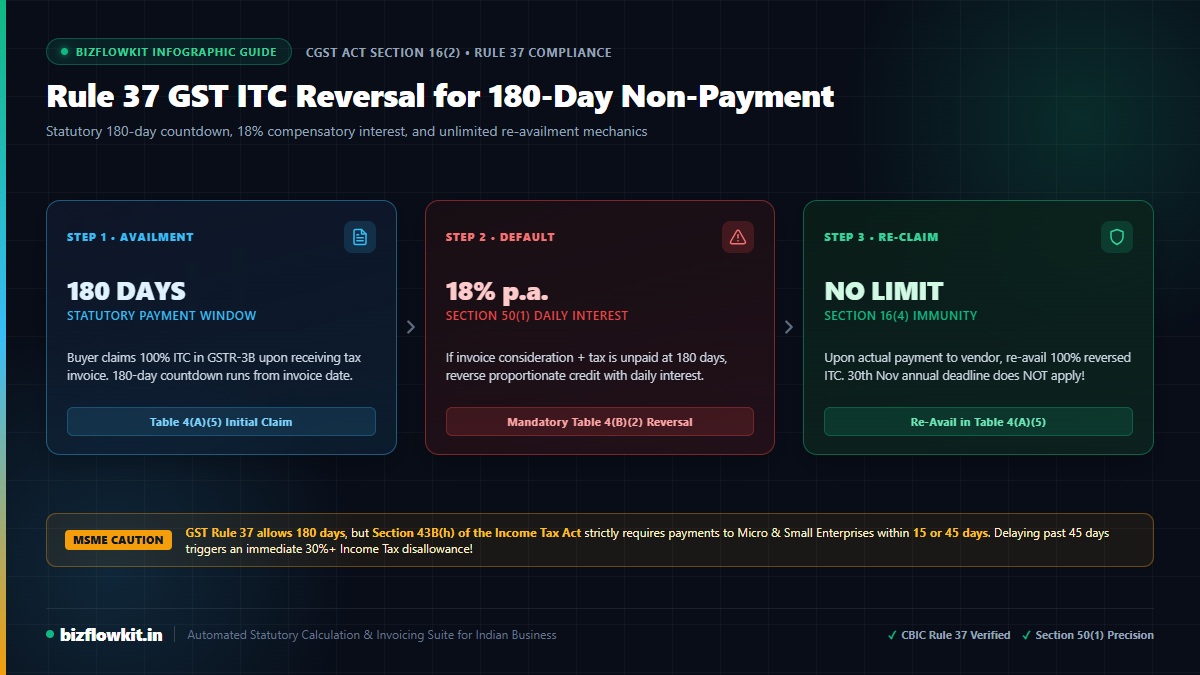
Under the Indian Goods and Services Tax (GST) framework, claiming Input Tax Credit (ITC) is not an unconditional statutory entitlement. The second proviso to Section 16(2) of the CGST Act 2017 read with Rule 37 of the CGST Rules 2017 establishes that if a buyer fails to pay the supplier the value of supply plus indirect taxes within 180 calendar days from the date of the invoice, the availed ITC must be mandatorily reversed in Form GSTR-3B along with 18% per annum interest under Section 50. This comprehensive guide breaks down the 180-day countdown mechanics, statutory interest liabilities, post-payment re-availment rights, and the dangerous friction between GST Rule 37 and Section 43B(h) of the Income Tax Act.
The 180-Day Payment Condition: Where a recipient fails to pay the supplier the amount towards the value of supply along with tax within 180 days from the invoice date, an amount equal to the input tax credit availed by the recipient shall be paid by him, or reversed, along with interest payable under Section 50, in Form GSTR-3B for the tax period immediately following the expiry of 180 days.
1. The Statutory Architecture: How Rule 37 Operates in FY 2026-27
Following statutory amendments introduced via Notification No. 19/2022-Central Tax and Notification No. 26/2022-Central Tax, Rule 37 was streamlined to eliminate earlier procedural ambiguities. The operational mechanics follow four strict legal pillars:
- The 180-Day Calendar Clock: The countdown starts from the date of issuance of the invoice, not the date of receipt of goods, date of delivery challan, or date of recording in accounting books.
- Proportionate Reversal (Rule 37(2)): If partial consideration or tax has been paid to the supplier before the 180-day mark, the reversal requirement applies strictly in proportion to the unpaid balance.
- Mandatory Section 50(1) Interest (18% p.a.): Interest accrues from the date the recipient availed the credit in their return until the date the credit is reversed.
- Subsequent Re-Availment Right (Section 16(2) Third Proviso): Once the recipient pays the supplier the outstanding consideration and tax, they can legally re-avail the reversed ITC in Table 4(A)(5) of Form GSTR-3B.
Departmental Scrutiny Under Section 61: GST officers cross-verify aged sundry creditors from your audited balance sheet and Form 3CD (Tax Audit Report) against your GSTR-3B reversals. If sundry creditors aged over 180 days have not been reflected as reversals in Table 4(B)(2), officers issue Form DRC-01 demanding 100% tax recovery plus 18% penal interest and Section 122 penalty.
2. Real-World Worked Scenario: Comprehensive Calculation Proof
Let us examine a concrete B2B transaction scenario to illustrate the exact mathematical impact of Rule 37:
Buyer Enterprise: Apex Machinery Works Pvt Ltd (Pune, Maharashtra).
Supplier: Bharat Alloy Castings LLP (Surat, Gujarat).
Invoice Issuance Date: 1 May 2026.
Taxable Base Value: ₹5,00,000.
IGST (18%): ₹90,000.
Total Invoice Value: ₹5,90,000.
Initial ITC Availment: Availed in Form GSTR-3B for May 2026 (filed on 20 June 2026).
180-Day Statutory Expiry Date: 28 October 2026.
Scenario Comparison: Partial Payment vs Full Default
| Payment Status at 180 Days | Amount Paid to Supplier | Unpaid Consideration | Mandatory ITC Reversal | 18% Section 50 Interest | Future Re-Claim Entitlement |
|---|---|---|---|---|---|
| Full Default (0% Paid) | ₹0 | ₹5,90,000 | ₹90,000 | ₹6,789 (153 Days) | ₹90,000 upon payment |
| 50% Partial Payment | ₹2,95,000 | ₹2,95,000 | ₹45,000 | ₹3,395 (153 Days) | ₹45,000 upon payment |
| 80% Substantial Payment | ₹4,72,000 | ₹1,18,000 | ₹18,000 | ₹1,358 (153 Days) | ₹18,000 upon payment |
| 100% Timely Settlement | ₹5,90,000 | ₹0 | ₹0 (No Reversal) | ₹0 Interest | Fully Retained |
*Delay days calculated from 20 June 2026 (May GSTR-3B filing) to 20 November 2026 (October GSTR-3B filing where reversal occurs). Interest rounded pursuant to Section 170.
3. Re-Availing Reversed ITC: The Section 16(4) Exemption
One of the most valuable statutory reliefs under the CGST Act concerns subsequent re-availment:
Statutory Immunity from the 30th November Deadline
Under the third proviso to Section 16(2) read with Rule 37(4), when the recipient pays the supplier at a future date (e.g. 1 or 2 years later), they are statutorily entitled to re-avail 100% of the reversed credit in Table 4(A)(5) (“All other ITC”) of Form GSTR-3B. Crucially, the annual 30th November deadline under Section 16(4) does NOT apply to re-availing Rule 37 credit. However, the Section 50(1) interest paid upon reversal is compensatory and cannot be recovered or reclaimed.
The MSME Compliance Trap: CFOs and accountants must beware of the critical conflict between GST and Income Tax timelines. While GST Rule 37 grants 180 days before forcing ITC reversal, Section 43B(h) of the Income Tax Act strictly requires payments to Micro and Small Enterprises within 15 days (or up to 45 days with a written contract). If you wait 180 days to pay an MSME vendor, your GST credit remains safe for 6 months, but you will suffer an immediate 30%+ income tax disallowance plus 3x RBI compound monthly interest under the MSMED Act! Check supplier payment clocks using the BizFlowKit MSME Interest Calculator.
4. Compliance Action Plan: How to Report in Form GSTR-3B
To ensure seamless reporting and avoid scrutiny notices under Section 61, follow this four-step reporting workflow:
- Track Aged Creditors Monthly: Generate an aging report of all unpaid B2B supplier invoices crossing 150 days. Send payment reminders before the 180-day deadline expires.
- Execute Table 4(B)(2) Reversal: In the GSTR-3B for the tax period immediately following the 180th day, enter the proportionate credit in Table 4(B)(2) – “Others”. Do not enter it in Table 4(B)(1) (which is reserved for permanent Rule 38, 42, 43 and Section 17(5) blocked credits).
- Compute & Pay Section 50 Interest: Enter the exact 18% p.a. interest in Table 5.1 – “Interest & Late Fees”. Verify your cash challan utilizing the BizFlowKit GST Interest Calculator.
- Re-Avail in Table 4(A)(5) Upon Disbursement: When the vendor is finally paid, include the re-claimed credit in Table 4(A)(5) – “All other ITC” and declare it in Table 4(D)(1) as re-claimed ITC.
Free Interactive Compliance Engine
Reconcile Input Tax Credit & Optimize Cash Settlement in GSTR-3B
Plan your monthly tax offset under Rule 88A, isolate cash challans, compute day-exact interest, and audit MSME vendor payment timelines with BizFlowKit’s verified financial suite.
5. Frequently Asked Questions (Statutory FAQs)
Q1: Does Rule 37 apply to supplies covered under Reverse Charge Mechanism (RCM)?
No. Section 16(2) second proviso explicitly excludes supplies where tax is payable on a reverse charge basis (such as GTA services, legal services, or director remuneration under Section 9(3) or 9(4)). The recipient can claim and retain RCM ITC upon tax payment without being subjected to the 180-day vendor payment condition.
Q2: Is the Section 50(1) interest paid during Rule 37 reversal refundable when the supplier is paid?
No. The interest paid under Section 50(1) is compensatory in nature for withholding government dues. While you can re-avail 100% of the reversed principal tax credit upon actual payment, the interest portion is a permanent cash outflow and cannot be reclaimed.
Q3: What happens if payment is made by book adjustment or mutual debt settlement?
Book adjustments, ledger contra-entries, and netting-off mutual debts constitute valid legal consideration under Section 2(31) of the CGST Act. The Authority for Advance Rulings (AAR) and Appellate Tribunals have repeatedly affirmed that settlement of dues via journal vouchers satisfies the payment requirement of Section 16(2), provided the ledger entries are legally valid and documented.
Q4: Does the Section 16(4) 30th November cut-off bar re-claiming Rule 37 ITC in future years?
No. Section 16(4) applies exclusively to claiming ITC for the first time in respect of an invoice or debit note. Re-availing credit previously reversed under Rule 37 is governed by the specific statutory permission of Section 16(2) third proviso and Rule 37(4), which contains no expiration or sunset timeline.
Q5: How does Rule 37 interact with retention money held under construction contracts?
Under commercial contracts where a percentage (e.g. 10%) is held as retention money until the end of a Defect Liability Period (e.g. 12 months), tax authorities routinely demand proportionate reversal after 180 days. To avoid this, businesses should either structure milestones through progressive invoicing or execute bank guarantee substitutions to legally discharge invoice consideration.
GST Calculator Online (Inclusive & Exclusive)
Compute accurate CGST, SGST, IGST splits and statutory rate brackets instantly with exportable tax breakup.