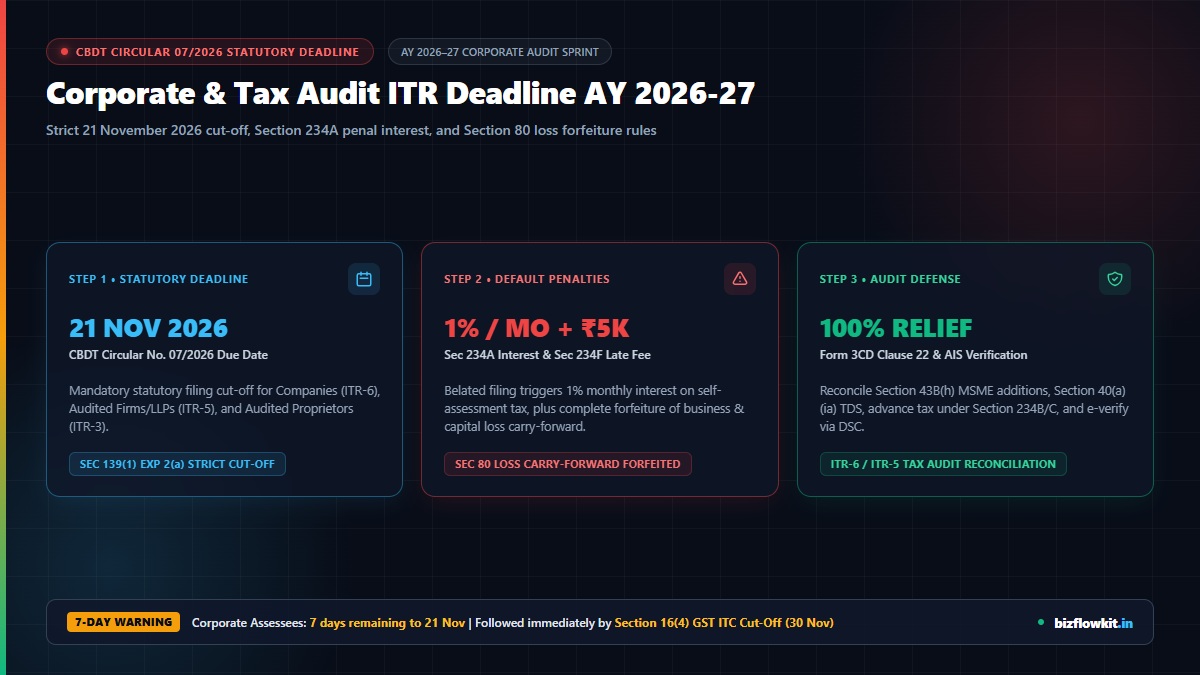
7 Days Remaining Until Final Cut-Off
Executive Summary: Extended Corporate ITR Due Date (21 November 2026)
Under Section 139(1) Explanation 2(a) of the Income Tax Act, 1961, read with CBDT Circular No. 07/2026, the statutory due date for filing Income Tax Returns for corporate assessees and all taxpayers subject to audit under Section 44AB has been extended to Saturday, 21 November 2026. With only seven days left, corporate finance teams, chartered accountants, and tax advisors must navigate tight reconciliation timelines to prevent catastrophic financial penalties.
A delay beyond 21 November 2026 triggers automatic Section 234A penal interest at 1% per month (even a 1-day delay incurs a full 30-day charge under Rule 119A), mandatory Section 234F fees, the permanent forfeiture of business and capital loss carry-forwards under Section 80, and statutory disqualification from opting out of the default Section 115BAC tax regime for non-corporate audits.
1. Statutory Framework: Who Must File by 21 November 2026?
Under the provisions of Section 139(1) of the Income Tax Act, 1961, the general statutory due date for assessees requiring an audit is 31 October of the assessment year. For Assessment Year 2026-27 (relating to Financial Year 2025-26), the Central Board of Direct Taxes (CBDT), exercising its powers under Section 119, issued Circular No. 07/2026 extending the filing deadline for returns of income to 21 November 2026.
This mandatory 21 November 2026 cut-off applies to the following categories of taxpayers:
- Corporate Assessees (ITR-6): All domestic companies, foreign companies, and private limited entities, irrespective of whether they have a profit, loss, or zero turnover.
- Tax Audit Assessees (ITR-5 / ITR-3): Partnership firms, LLPs, sole proprietorships, and Hindu Undivided Families (HUFs) whose accounts are mandatory to be audited under Section 44AB (turnover exceeding ₹1 Crore for business without digital thresholds, or exceeding ₹10 Crores where 95% or more of transactions are through digital modes).
- Working Partners of Audited Firms: Any partner of a firm whose accounts are required to be audited under Section 44AB or under any other law.
Important Distinction: Tax Audit Report vs. ITR Submission
Please note that the Tax Audit Report (Form 3CA/3CB and Form 3CD) was required to be submitted one month prior to the original due date (i.e. by 31 October 2026). The current 21 November 2026 deadline specifically applies to the Return of Income (ITR-6 / ITR-5 / ITR-3) and tax audit acknowledgment ingestion on the e-filing portal.
2. Section 234A Interest: How Delay Compounds Your Tax Bill
Section 234A levies compensatory interest for defaults in furnishing the return of income within the prescribed due date. If an eligible corporate or audited assessee files after 21 November 2026, interest begins accruing immediately from 22 November 2026 until the date the return is successfully verified.
Rule 119A Mandated
Where Net Assessed Tax equals:
− Advance Tax Paid (under Section 208/211)
− Tax Deducted / Collected at Source (TDS/TCS under Section 199/206C)
− MAT Credit Relieved (under Section 115JAA)
− Relief Claimed under Section 89 / 90 / 90A / 91
Critical Rule 119A Note: Any fraction of a month is rounded up to a full month. If you file on 22 November 2026 (a single day past the deadline), you are charged for one full month (1%). If you file on 23 December 2026, you cross into the second calendar interval, incurring two full months (2%).
Worked Example: Corporate Assessee with Late Filing
Consider Apex Automations Pvt Ltd, subject to statutory tax audit for FY 2025-26 (AY 2026-27):
- Total Tax Liability computed on taxable profits: ₹42,00,000
- TDS credits available on 26AS/AIS: ₹12,00,000
- Advance Tax deposited across quarterly installments: ₹20,00,000
- Remaining Self-Assessment Tax balance: ₹10,00,000
If Apex Automations files on 21 November 2026, Section 234A interest is ₹0. If the company delays and files on 23 November 2026 (just 2 days late) without paying self-assessment tax before the due date, Rule 119A rounds the 2 days up to 1 full month:
Plus Section 234F Late Fee = ₹5,000
Total Immediate Additional Outflow = ₹15,000 (excluding cumulative 234B/234C interest)
Tactical Pro-Tip: Neutralizing Section 234A with Section 140A Challan
Interest under Section 234A is calculated strictly on the tax remaining unpaid. If your accounts or schedules cannot be finalized by 21 November, compute an estimated tax liability and deposit 100% of the self-assessment tax via Challan ITNS 280 (Minor Head 300) on or before 21 November 2026. This reduces the net unpaid assessed tax base to zero, legally extinguishing Section 234A interest even if the XML return is uploaded later.
3. Section 80 Loss Forfeiture: The Irreversible Cost of Belated Filing
While penal interest is costly, the most devastating consequence of missing the 21 November 2026 deadline is the statutory forfeiture of losses under Section 80 read with Section 139(3).
Section 80 of the Income Tax Act explicitly provides that no loss shall be carried forward and set off under sub-section (1) of Section 72 (Business Losses), sub-section (2) of Section 73 (Speculative Business Losses), sub-section (2) of Section 73A (Specified Business Losses under Section 35AD), sub-section (1) of Section 74 (Capital Losses), or sub-section (3) of Section 74A (Loss from Maintaining Race Horses), unless the return of income is furnished on or before the due date specified under Section 139(1).
Critical Risk: No Condonation for Normal Delays
Do not rely on Section 119(2)(b) condonation petitions for carried-forward losses. Condonation of delay by the Principal Chief Commissioner is granted strictly under extraordinary hardship (e.g. natural disaster, incapacitation). Missing the deadline due to audit delays, vendor reconciliation disputes, or late book closing leads to summary rejection and irrecoverable tax loss forfeiture.
4. Critical Audit Disallowances: Form 3CD Ingestion in ITR
When filing corporate and audited returns, figures declared in the Tax Audit Report (Form 3CD) must match the Schedule BP and other business schedules in ITR-6 or ITR-5 down to the last rupee. Two clauses in Form 3CD require heightened scrutiny for AY 2026-27:
A. Clause 22: MSME Section 43B(h) Disallowances
Under Section 43B(h), any sum payable by the assessee to a registered Micro or Small Enterprise beyond the time limit specified in Section 15 of the MSMED Act, 2006 (15 days without agreement, or up to 45 days under written agreement) is disallowed and added back to taxable income for FY 2025-26.
- The Section 43B Proviso Trap: Unlike taxes, bonuses, or PF dues where payments made up to the ITR filing date (21 November 2026) are deductible, the proviso to Section 43B explicitly excludes clause (h). If a payment to an MSME vendor was overdue as of 31 March 2026 and cleared in May 2026, it is still disallowed in FY 2025-26 and can only be claimed in FY 2026-27 upon actual payment.
- Rule 37 GST Cross-Impact: If supplier invoices are aged past 180 days, ensure you also review your GST compliance under Rule 37 GST ITC Reversal Guidelines to avoid simultaneous GST 18% interest penalties.
B. Clause 21(a): Section 40(a)(ia) TDS Disallowances
Any resident expenditure (contractual payments, professional fees, commissions, rent) where TDS was not deducted, or where TDS was deducted during FY 2025-26 but not deposited to the Central Government on or before the Section 139(1) due date (21 November 2026), triggers a mandatory 30% disallowance under Section 40(a)(ia). Cross-verify all vendor deductions against the latest TDS Rate Chart & Compliance Guide.
5. Practical Scenarios: Financial Impact of Timely vs. Belated Filing
To illustrate the cumulative financial repercussions across different organizational profiles, review the four comparative scenarios below:
6. 7-Day Corporate Tax Audit Action Roadmap (14–21 November 2026)
Do not leave filing to the final evening of 21 November when government servers experience heavy portal latency. Follow this systematic day-by-day execution checklist:
Frequently Asked Questions (FAQ)
1. Is the 21 November 2026 deadline applicable to all taxpayers in India?
No. The 21 November 2026 deadline under CBDT Circular No. 07/2026 applies specifically to corporate assessees (companies), non-corporate taxpayers required to get their accounts audited under Section 44AB, and working partners of audited firms. Non-audited individual and HUF returns for AY 2026-27 expired on 31 July 2026.
2. If I pay 100% of my tax liability before 21 November, do I still face Section 234A interest?
No. Section 234A interest is levied strictly on the net tax remaining unpaid after deducting advance tax, TDS/TCS, and self-assessment tax paid before the due date. If net unpaid tax is ₹0, interest is ₹0. However, filing late will still trigger a Section 234F late fee (up to ₹5,000) and the catastrophic forfeiture of business and capital losses under Section 80.
3. Can unabsorbed depreciation be carried forward if the return is filed belatedly?
Yes. Section 80 restricts the carry-forward of business losses (Section 72), speculative losses (Section 73), and capital losses (Section 74). Unabsorbed depreciation is governed independently by Section 32(2) and is not mentioned in Section 80. Therefore, unabsorbed depreciation can be carried forward indefinitely even if your ITR is filed belatedly under Section 139(4).
4. What happens if a partnership firm files after 21 November and wants the Old Tax Regime?
Under Section 115BAC(6), assessees with business income who wish to opt out of the new default tax regime must furnish Form 10-IEA on or before the due date specified under Section 139(1). If the return is filed belatedly, Form 10-IEA is invalid, forcing the firm into the new tax regime and forfeiting eligible chapter VI-A deductions.
5. What is the final cut-off date to file a belated or revised return for AY 2026-27?
Under Section 139(4) (belated return) and Section 139(5) (revised return), the ultimate deadline to submit a return for Assessment Year 2026-27 is 31 December 2026 (or three months prior to the end of the relevant assessment year, whichever is earlier). After 31 December 2026, you can only file an Updated Return under Section 139(8A) (ITR-U) with severe additional tax penalties of 25% to 50%.