Income Tax Act 1961
Executive Summary: Advance Tax Mandate & Penal Interest Architecture
Under Section 208 of the Income Tax Act, 1961, advance tax is mandatory for every taxpayer whose estimated net tax liability for the financial year (after deducting TDS, TCS, and eligible foreign tax credits) equals or exceeds ₹10,000. This statutory obligation applies equally to salaried individuals with other income, freelancers, corporate enterprises, partnership firms, and Hindu Undivided Families (HUFs).
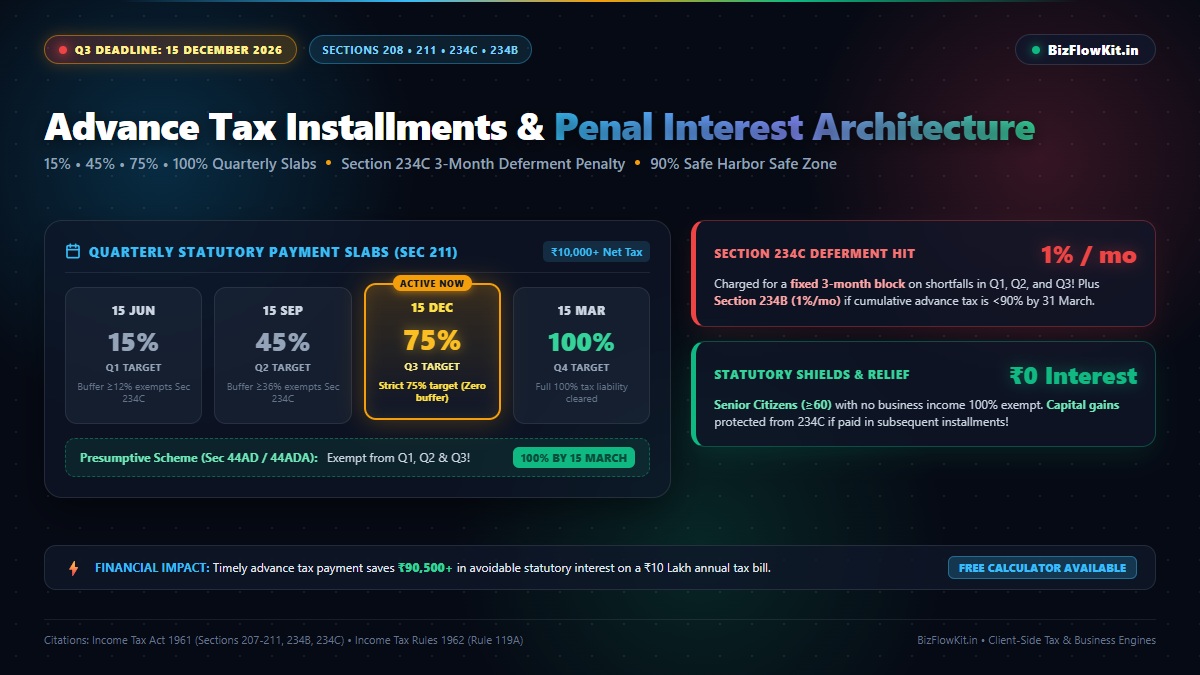
Failing to pay advance tax or deferring quarterly installments triggers dual compounding penalties: Section 234C interest (charged at 1% per month for 3 months on quarterly deferments) and Section 234B interest (charged at 1% per month from 1 April if total advance tax paid falls below the 90% statutory safe-harbor). With the third major milestone (Q3 – 75% cumulative threshold) falling due on 15 December 2026, proactive tax estimation is critical to protect capital.
1. Statutory Framework: Who Must Pay Advance Tax?
The mandate to pay advance tax is codified under Sections 207 to 211 of the Income Tax Act, 1961. Any person whose estimated tax liability for the financial year is ₹10,000 or more after deducting TDS/TCS is liable to pay advance tax in specified installments.
This legal obligation applies across all taxpayer categories:
- Corporate Assessees (Companies): All domestic and foreign companies operating in India, regardless of whether they are profitable, zero-turnover, or subject to Minimum Alternate Tax (MAT) under Section 115JB.
- Business Entities & LLPs: Partnership firms, LLPs, and sole proprietors having business income.
- Salaried Employees with Other Income: While employers deduct TDS under Section 192, employees earning substantial capital gains, rental income, consulting fees, or interest on fixed deposits must pay advance tax if their residual tax liability exceeds ₹10,000.
- Freelancers & Professionals: Consultants, doctors, software developers, and legal practitioners earning professional fees subject to only 10% TDS under Section 194J.
Statutory Exemption for Senior Citizens (Section 207(2))
Under Section 207(2), a resident individual who is 60 years of age or older at any time during the financial year is completely exempt from paying advance tax, provided they do NOT have any income chargeable under the head “Profits and Gains of Business or Profession” (PGBP). Senior citizens with pension, rental income, capital gains, or interest income can discharge their entire tax liability at the time of filing their ITR via Self-Assessment Tax without attracting Section 234B or 234C interest!
2. Advance Tax Installment Calendar & Statutory Slabs (Section 211)
Under Section 211(1), advance tax must be deposited in four scheduled tranches during the financial year. Each installment requires a cumulative percentage of the total estimated tax payable:
Special Advantage: Presumptive Taxation Single Installment
Under Section 211(1) second proviso, taxpayers declaring profits under the presumptive taxation schemes of Section 44AD (small businesses up to ₹3 Crores turnover) or Section 44ADA (professionals up to ₹75 Lakhs gross receipts) are NOT required to pay quarterly advance tax in June, September, or December. They can pay 100% of their advance tax in a single tranche on or before 15 March without incurring Section 234C interest!
3. Section 234C Interest: The Cost of Quarterly Deferment
When a taxpayer fails to pay the specified percentage of advance tax by the quarterly due dates, interest under Section 234C is levied at the rate of 1% per month on the shortfall:
Rule 119A Mandated
Q2 Shortfall = (45% of Assessed Tax − Tax Paid by 15 Sept) × 1% × 3 Months
Q3 Shortfall = (75% of Assessed Tax − Tax Paid by 15 Dec) × 1% × 3 Months
Q4 Shortfall = (100% of Assessed Tax − Tax Paid by 15 March) × 1% × 1 Month
Why 3 Months for Q1, Q2, and Q3?
The statute mandates a fixed penalty multiplier of 3 months for the first three installments because they represent quarterly deferment periods (June to Sept, Sept to Dec, Dec to March). Even if you deposit the shortfall a week after the due date, Section 234C interest is charged for the full 3-month statutory period!
Statutory Shield: Windfall Income & Capital Gains (Section 234C Proviso)
Because taxpayers cannot predict unexpected capital gains (e.g. sale of shares, property sale) or lottery/speculative winnings at the beginning of the financial year, the proviso to Section 234C(1) provides vital statutory protection:
- No Section 234C interest is charged on the shortfall arising from capital gains, lottery winnings, dividend income, or income from a newly commenced business.
- Condition for Relief: The taxpayer must deposit 100% of the advance tax on such unexpected income in the remaining advance tax installments that fall due after the date of accrual or realization (or by 31 March if the gain occurs after 15 March).
4. Section 234B Default Interest: The 90% Safe Harbor Rule
While Section 234C penalizes quarterly deferment during the financial year, Section 234B penalizes failure to pay adequate advance tax on an annual basis:
- The 90% Safe Harbor: If the total advance tax deposited by 31 March is 90% or more of the assessed tax, Section 234B interest is ₹0.
- The Default Penalty: If total advance tax deposited is less than 90% of assessed tax (or if zero advance tax was paid), interest is charged at 1% per month (or part of a month) on the entire unpaid assessed tax base.
- Duration of 234B Interest: The clock starts ticking on 1 April of the assessment year and runs continuously until the date of determination of total income under Section 143(1) or the date of payment of self-assessment tax.
5. Worked Case Study: Financial Repercussions of Delayed Payment
Consider Apex Engineering Services LLP, with an assessed net tax liability of ₹10,00,000 for FY 2026-27 (after TDS credits):
By simply depositing advance tax in accordance with Section 211, the compliant assessee pays exactly ₹0 in interest, saving ₹90,500 on a ₹10 Lakh tax bill!
6. Practical Profiles: Navigating Advance Tax Obligations
Review the four typical taxpayer profiles below to assess your specific advance tax compliance strategy:
7. Q3 15 December Action Checklist: 4-Step Tax Planning Sprint
With the 15 December 2026 deadline approaching for the 75% cumulative threshold, execute this operational checklist:
- Step 1: Ingest Form 26AS & AIS — Download your latest Annual Information Statement (AIS) to capture all TDS deductions, TCS credits, and dividend credits deposited by payers through Q2 and Q3.
- Step 2: Aggregate Realized Capital Gains — Download capital gains statements from your stockbroker or mutual fund depository (CAMS/KFintech) up to 30 November 2026. Calculate net short-term gains (20%) and long-term gains (12.5% beyond ₹1.25L).
- Step 3: Forecast Total Annual Tax — Run your estimated numbers through BizFlowKit’s free Advance Tax Calculator to determine exact net tax payable. Multiply by 75% to identify the required cumulative deposit.
- Step 4: Deposit via Challan ITNS 280 (Minor Head 100) — Navigate to the e-Pay Tax tab on the Income Tax Portal. Select Assessment Year 2027-28 (FY 2026-27), select “Advance Tax (100)”, and complete the online transfer via Net Banking or UPI.
Frequently Asked Questions (FAQ)
1. If my employer already deducts TDS on salary, do I still need to pay advance tax?
If salary is your only source of income, your employer deducts tax under Section 192, and you generally do not need to pay advance tax. However, if you earn interest from fixed deposits, rental income, capital gains from shares, or freelance fees, and the tax liability on this additional income exceeds ₹10,000, you MUST calculate and pay advance tax on the shortfall.
2. What happens if I pay tax on 16 December instead of 15 December?
Under Rule 119A of the Income Tax Rules, any fraction of a month is rounded up to a full month. Depositing your advance tax even one day late (on 16 December) triggers the full 3-month Section 234C interest penalty at 1% per month on the shortfall!
3. Can tax paid after 15 March be considered advance tax?
Under Section 211(1) Explanation, any amount paid by way of advance tax on or before 31 March of the financial year is treated as advance tax paid during that financial year. While it will attract Section 234C interest for delaying past 15 March, it will successfully prevent Section 234B interest starting on 1 April.
4. Are senior citizens required to pay advance tax on stock market gains?
Under Section 207(2), a resident individual aged 60 years or above is exempt from advance tax as long as they have NO business or professional income (PGBP). Capital gains from stock market trading (investments held as capital assets) do NOT constitute business income. Therefore, a retired senior citizen with capital gains is fully exempt from advance tax!
5. Which minor head challan should be used for paying advance tax?
When paying online through the Income Tax Portal (Challan ITNS 280), select Type of Payment as “Advance Tax (100)”. Selecting “Self-Assessment Tax (300)” by error during the financial year will result in the portal categorizing it improperly and assessing Section 234B/234C interest.