GST Credit Notes & Debit Notes (Section 34) FY 2025-26: 30 November 2026 Cut-Off, Buyer ITC Reversal & IRN Rules
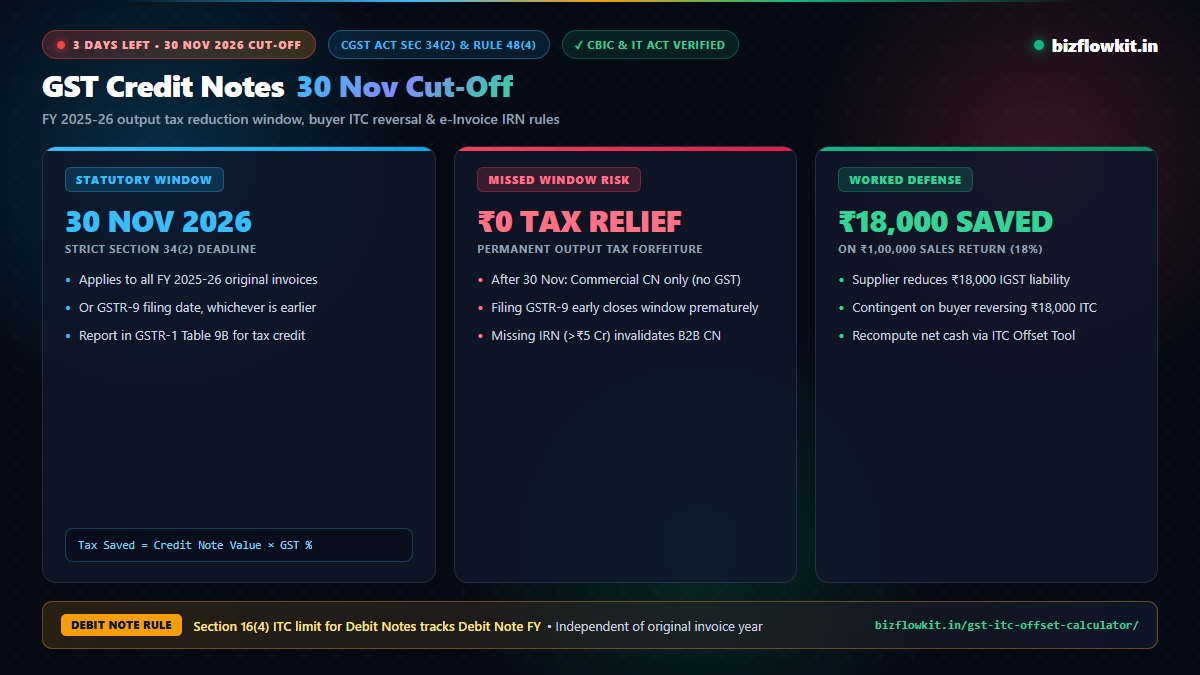
With 30 November 2026 strictly 3 days away, suppliers across India face an absolute statutory cut-off under Section 34(2) of the CGST Act 2017 to declare GST Credit Notes for invoices issued during FY 2025–26. Missing this window permanently forfeits your right to reduce output GST liability on sales returns, price revisions, or deficient services—turning recoverable GST into an unrecoverable P&L expense. Verify your ITC and tax offset exposure immediately using the BizFlowKit GST ITC Offset Calculator.
Section 34(2) Hard Time-Bar: Any GST Credit Note pertaining to an original invoice from FY 2025–26 (1 April 2025 to 31 March 2026) must be declared in Form GSTR-1 on or before 30 November 2026, or the date of filing the annual return (GSTR-9), whichever is earlier. Filing GSTR-9 prior to 30 November prematurely closes your credit note reporting window.
1. When Must You Issue a GST Credit Note vs. Debit Note?
- GST Credit Note (Section 34(1)): Issued by the supplier when taxable value or tax charged in the original tax invoice exceeds the actual taxable value or tax payable (e.g., goods returned, post-supply agreed discount under Section 15(3)(b), or service deficiency).
- GST Debit Note (Section 34(3)): Issued when the original invoice charged less taxable value or lower tax than payable. Crucially, under Section 16(4), the ITC time-bar for a Debit Note is linked to the financial year of the debit note date itself, not the original invoice date.
Two Mandatory Prerequisites: (1) A supplier’s output tax reduction via a GST Credit Note is legally contingent upon the registered buyer reversing the corresponding Input Tax Credit in GSTR-3B. (2) Businesses with Aggregate Annual Turnover exceeding ₹5 Crore under Rule 48(4) must generate an e-Invoice IRN and QR code on all B2B Credit Notes and Debit Notes via the IRP.
After 30 Nov 2026: Statutory GST Reduction = ₹0 (Commercial Credit Note Only)
2. Verified Worked Example: FY 2025–26 Sales Return Before vs. After 30 Nov 2026
Scenario: An industrial supplier issued a B2B IGST invoice on 15 January 2026 (FY 2025–26) for ₹5,00,000 plus 18% IGST (₹90,000). In October 2026, 20% of the goods (₹1,00,000 taxable value + ₹18,000 IGST = ₹1,18,000) were rejected and returned.
| Compliance Parameter | Declared by 30 Nov 2026 (Statutory GST CN) | Missed 30 Nov 2026 (Commercial CN Only) |
|---|---|---|
| Returned Goods Value | ₹1,00,000 | ₹1,00,000 |
| IGST Liability Reduction (18%) | ₹18,000 Output Tax Reduced | ₹0 (Permanent Tax Loss) |
| Portal & IRP Reporting | Reported in GSTR-1 Table 9B (+ IRN if > ₹5 Cr) | Cannot be reported for tax reduction |
| Buyer ITC Impact | Buyer reverses ₹18,000 ITC | No GST adjustment; accounting entry only |
Do Not File GSTR-9 Early If Credit Notes Are Pending: Because Section 34(2) stipulates 30 November or the date of filing Annual Return GSTR-9, whichever is earlier, submitting your FY 2025–26 GSTR-9 in mid-November locks your credit-note reduction window early. Complete all pending GSTR-1 amendments and Section 34 credit notes before submitting GSTR-9.
Recalculate Your Net Cash Tax After Credit Note & ITC Reversals
Verify how credit-note reversals and Section 16(4) cut-off adjustments reshape your IGST, CGST, and SGST Electronic Credit Ledger waterfall before filing GSTR-3B.
3. Frequently Asked Questions (Section 34 Credit & Debit Notes)
Can I issue a commercial credit note after 30 November 2026?
Yes, a commercial/financial credit note without GST can still be issued for accounting settlement, but you cannot reduce your GST output tax liability on the GST portal after 30 November 2026 for FY 2025–26 supplies.
Does the 30 November cut-off also apply to GST Debit Notes?
No. Under amended Section 16(4), a recipient’s deadline to claim ITC on a Debit Note is linked to the financial year in which the Debit Note is issued, independent of the original invoice’s financial year.
Is e-Invoicing mandatory for Credit Notes if turnover exceeds ₹5 Crore?
Yes. Under Rule 48(4), notified taxpayers with AATO > ₹5 Crore must generate an IRN and QR code for B2B invoices, export invoices, Credit Notes, and Debit Notes.
What happens if the buyer refuses to reverse ITC on my Credit Note?
Under Section 34(2) proviso, no reduction in the supplier’s output tax liability is permitted unless the recipient reverses the proportionate ITC attributable to that credit note.