How to Outsource Bookkeeping for Small Business (Step-by-Step Guide 2026)
For many small business owners, the early days are fueled by passion and big ideas. But as your business grows, that passion often gets buried under a mountain of paperwork.
You might at times find yourself working overtime trying to balance books, track expenses, or figure out payroll taxes instead of focusing on your customers. In fact, research highlights that 40% of small business owners tend to spend over 80 hours per year on bookkeeping tasks, time that could be used for growth.
It is exactly where the decision to outsource bookkeeping for small businesses becomes a strategic decision. In 2026, outsourcing is not just about cutting costs. It is, in fact, about gaining access to expertise, improving accuracy, and freeing up time to focus on growth.
This step-by-step guide walks you through everything you need to know about how to outsource bookkeeping.
The Real Benefits: Why Outsource Your Bookkeeping?
Did you know that according to Clutch, 37% of small businesses outsource at least one business process, with accounting being among the top functions?
Why are so many businesses moving away from having an in-house bookkeeper? It comes down to three main things: time, money, and peace of mind.
1. Big Savings on Costs
Hiring a full-time employee is expensive. You have to pay a salary, insurance, office rent, and buy expensive accounting software. When you choose to outsource bookkeeping services for your small business, you cut out those extra costs.
You only pay for the work that actually gets done. Moreover, even a study by Deloitte explains that companies can save costs by accounting outsourcing.
2. Expert Eyes on Your Money
Bookkeeping in 2026 involves more than just writing down numbers. It requires knowledge of the latest tax laws and digital tools. Outsourcing the bookkeeping allows you access to a team of experts who do this all day, every day. They stay updated, so you don’t have to.
3. Scaling Made Easy
If your business has a busy month, an outsourced team can handle the extra work instantly. If things slow down, you can scale back. You aren’t stuck with a fixed salary that you have to pay even when business is quiet.
4. Improved Accuracy
Errors in bookkeeping will eventually lead to penalties and poor financial decisions. Outsourcing accounting will lead to higher accuracy and compliance.
5. Time Savings
Instead of spending hours managing books, you can focus on strategy, sales, and customer experience.

Step-by-Step Guide: How to Outsource Bookkeeping?
If you’ve never done it before, how to outsource bookkeeping might seem a bit overwhelming. Let’s break it down into simple steps.
Step 1: Assess Your Bookkeeping Needs
Start by identifying what you need help with. It is important to get clarity as it helps you choose the right outsourced bookkeeping for a small business solution. It is best to ask yourself:
- Do you need basic bookkeeping or full financial management?
- Are you struggling with payroll, tax filings, or reporting?
- How many transactions do you handle monthly?
Step 2: Set a Budget
Understanding how much it costs to outsource bookkeeping is essential before you begin. Think about how much you are currently spending on bookkeeping (including your own time!). Use this to set a budget for outsourced bookkeeping for a small business. Remember, the goal is to save money while getting better results.
Outsourcing to countries like India via providers like BizFlowKit can drastically reduce these costs while maintaining optimum quality.
Step 3: Choose the Right Outsourcing Partner
This is one of the most important steps. A reliable partner ensures smooth operations. It is best to look for:
- Proven experience in outsourced bookkeeping services for small businesses
- Strong client testimonials
- Expertise in tools like QuickBooks, Xero, or Zoho Books
- Pricing structure that is transparent in nature
- Data security and compliance practices
Step 4: Check Technology and Tools
Your outsourcing partner needs to be proficient in modern accounting software or tools like QuickBooks, Xero, FreshBooks, or Zoho Books. Cloud-based tools ensure real-time access, better collaboration, and improved transparency.
Step 5: Define Scope and Expectations
It is important to outline your requirements clearly:
- Tasks to be handled
- Reporting frequency
- Communication channels
- Turnaround times
Defining such details will help to get rid of confusion and ensure accountability in your outsourcing of the small business bookkeeping process.
Step 6: Ensure Data Security
Financial data is very sensitive in nature. Make sure your provider follows strict security protocols. Hence, it is necessary to check for data encryption, secure access controls, and compliance as per international standards. Reliable outsourcing is known to prioritize confidentiality and data protection.
Step 7: Start with a Trial Run
Before you hand over everything, start with a small project for a short period of time. Maybe have them clean up your books from the last three months. This allows you to see how they communicate as well as how accurate their work is before you sign a long-term deal.
Step 8: Monitor and Optimize
Outsourcing is not a one-time setup. It is necessary to review the performance regularly. Continuous improvement will help you get maximum value from your outsourced bookkeeping services for your small business.
Track:
- Accuracy of reports
- Timeliness of deliverables
- Overall financial insights
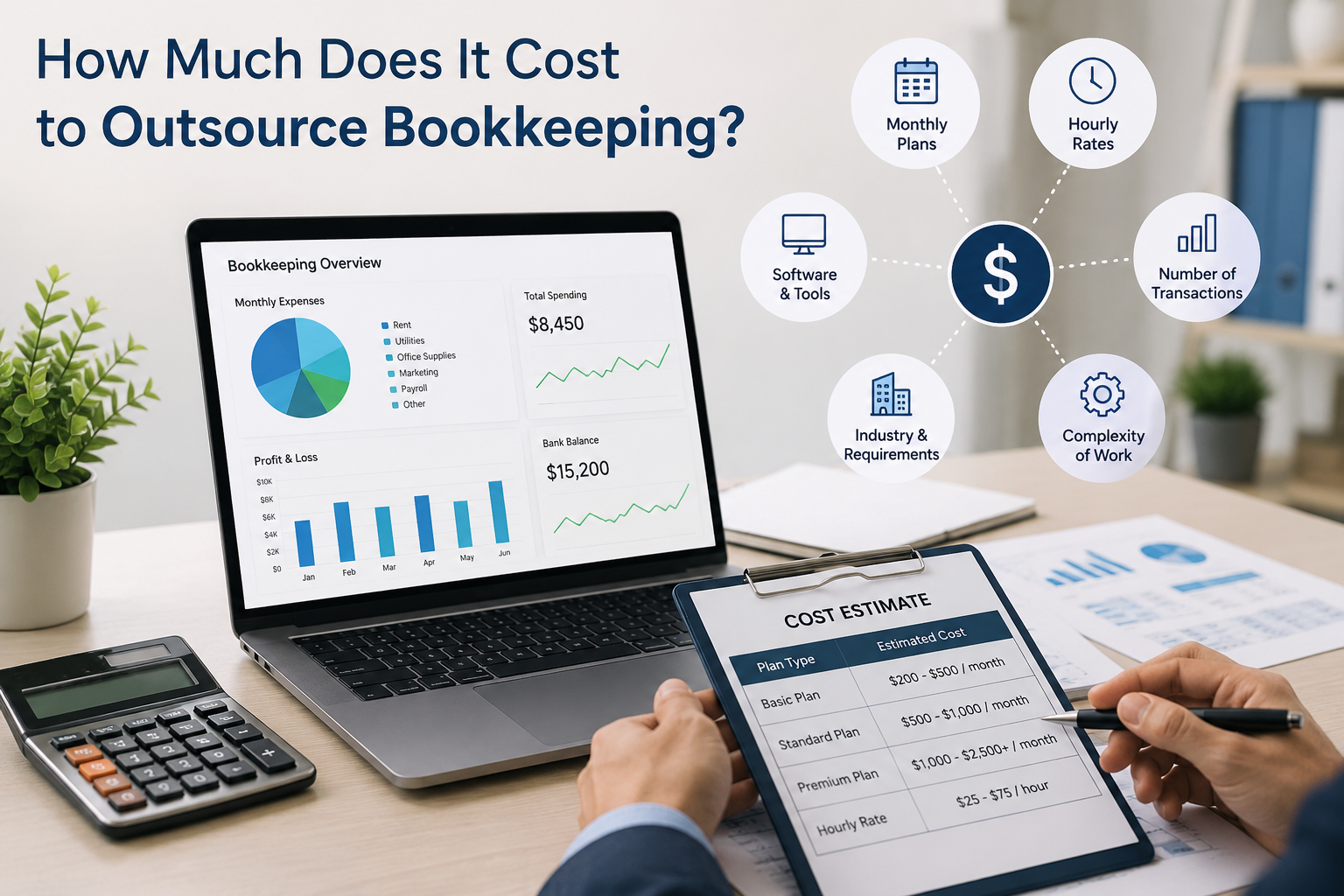
How Much Does It Cost to Outsource Bookkeeping?
One of the biggest hurdles for owners is wondering, “How much does it cost to outsource bookkeeping?” The good news is that it is very flexible.
| Business Size | What You Get | Estimated Monthly Cost |
| Small Startup | Basic data entry & bank matching | $200 – $400 |
| Growing Business | Payroll, bills, and monthly reports | $400 – $900 |
| Large/Complex | Full-service financial management | $900 – $2,500+ |
Common Mistakes to Avoid
Even when you hire the best outsourced bookkeeping for your small business, it is necessary to avoid these pitfalls:
- Buying on Price Alone: The cheapest service often leads to costly errors.
- Vague Expectations: Be specific about deadlines as well as the reports you need.
- Weak Security: Always verify that your partner uses enterprise-grade encryption.
- Zero Communication: Treat your offshore team as a partner, not just a vendor.
- Ignoring Reports: Always review the final numbers so that you stay in control of your profit.
Being proactive helps you fully leverage outsourcing.
Conclusion
Outsourcing bookkeeping is no longer optional for growing businesses. It is a smart move that improves efficiency, reduces costs, and enhances financial clarity.
If you are still managing books manually or struggling with accuracy, it is time to act. When you follow this easy step-by-step guide, you can transition to outsourced bookkeeping for a small business in a confident manner and focus on what essentially matters: building and scaling your business.
Frequently Asked Questions
What does it mean to outsource bookkeeping for a small business?
It essentially refers to hiring an external provider to manage financial records, transactions, reconciliations, and reports instead of handling them internally, which helps improve efficiency, accuracy, compliance, and financial decision-making for growing businesses.
How much does it cost to outsource bookkeeping?
The typical cost will range from $200 to $1000 per month. It will depend on the task complexity, transaction volume, reporting requirements, and level of expertise needed for your business operations.
Can I outsource bookkeeping if I have a very small business?
Yes, even small businesses can opt for outsourcing bookkeeping to reduce the workload, maintain accurate records, ensure compliance, and gain professional financial insights without the cost of hiring full-time staff.
What tasks can be outsourced in bookkeeping?
It is possible to outsource tasks like transaction recording, bank reconciliations, payroll processing, accounts payable and receivable, financial reporting, and even tax preparation, depending on the service package you select.
How long does it take to transition to outsourced bookkeeping?
The transition typically takes a few days to a couple of weeks, which depends on the complexity of your financial data, existing systems, and how quickly processes and tools are set up.
Can outsourced bookkeeping services handle taxes?
Many outsourcing providers also provide services with respect to tax preparation, filing, and compliance support. However, it is essential to confirm the scope of services before finalizing your agreement.
Can outsourcing help improve cash flow management?
Yes, with outsourcing, companies can get accurate tracking of income and expenses, reporting on a timely basis, and expert insights, which help identify cash flow gaps and improve financial planning and overall business stability.
Can I switch providers if I am not satisfied?
Yes, you can switch providers in case you are not satisfied. However, it is necessary to ensure proper data transfer, documentation, and transition planning. It will help to avoid disruptions and maintain continuity in your financial operations.
Test Your Numbers on BizFlowKit
Calculate GST rates, verify statutory filing deadlines, and prevent late fee penalties with 100% client-side privacy.