Calcutta HC Orders Electricity Duty to Be Considered Under IT Section 80-IA Valuation | Biz Flow Kit
The Calcutta High Court recently delivered a significant judgment on the valuation methods under Section 80-IA of the Income-tax Act.
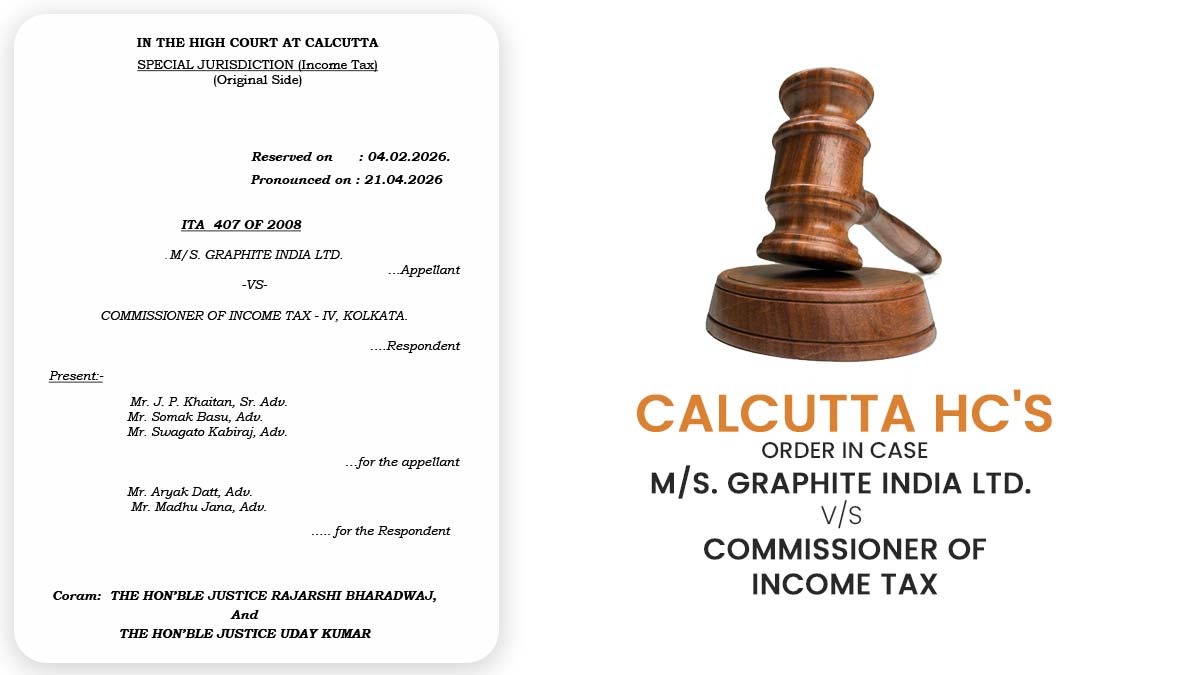
The division bench, which included Justice Rajarshi Bharadwaj and Justice Uday Kumar, made a clear observation that whenever a financial receipt is officially categorised as capital in nature, it cannot be treated as regular income for the calculation of MAT (Minimum Alternate Tax) unless the law explicitly provides otherwise. Therefore, such a subsidy has to be strictly excluded from the computation of book profits.
The main controversy that the Court had to resolve here was figuring out the correct market value of the electricity that is generated and captively consumed by the assessee’s own power-generating units, specifically for claiming deductions under Section 80-IA.
Initially, the Assessing Officer and the Tribunal decided to completely leave out the electricity duty portion from the standard tariff rates that are usually charged by State Electricity Boards when calculating this value.
However, the High Court strongly disagreed with this method. They clarified that the standard tariff set by State Electricity Boards is actually a composite price, which inherently includes the electricity duty.
By leaning on the Supreme Court’s ruling in the case of CIT v. Jindal Steel and Power Ltd., the bench declared that artificially removing any piece of this standard tariff is simply impermissible, thereby ruling in favour of the assessee on this specific matter.
Also Read: Export Profit Deductions U/S 80-HH Can Be Computed Without Reducing Income by 80-IA/80-IB Claims
Moving on to another crucial topic, the Court examined whether the deduction claimed under Section 80-IA needed to be proportionally reduced while calculating the deduction under Section 80HHC. The Court firmly decided that such a reduction is completely unwarranted if these deductions are coming from totally independent sources of income.
The Revenue Department had tried to use Section 80-IA(9) to stop what they believed was a double deduction. But the High Court stepped in to clarify that this specific provision is only meant to restrict claiming a double deduction on the same profits, and it absolutely does not apply when the streams of income are separate and distinct.
To back this up, they referenced earlier judicial precedents like Shital Fibres Ltd. v. CIT and CIT v. Shah Alloys Ltd. Another major dispute was about the exact nature of the sales tax remission that the assessee managed to receive under the West Bengal Incentive Scheme, 1993.
Also Read: IT Section 153C Proceedings Require Both Incriminating Material and Dual AO Satisfaction
Even though the Tribunal had originally treated this subsidy as being revenue in nature, the High Court decided to apply the widely accepted “purpose test”. By doing so, they concluded that the main goal of the subsidy was to encourage industrial expansion and that it was directly tied to capital investment.
Relying heavily on past decisions such as CIT v. Ponni Sugars and Chemicals Ltd. and CIT v. Shree Balaji Alloys, the Court finalised that this subsidy actually constituted a capital receipt and therefore, it is not chargeable to tax.
Finally, the court took a close look at whether this kind of capital subsidy should be added to the calculation of book profits under Section 115JB when assessing the Minimum Alternate Tax (MAT). They held their ground, stating that once a receipt is firmly characterised as a capital receipt, there is no way it can be treated as income for MAT purposes unless there is a specific provision under the statute that says otherwise.
Trusting the rulings in Apollo Tyres Ltd. v. CIT and PCIT v. Ankit Metal & Power Ltd., the Court ordered that the subsidy must definitely be excluded from book profits. In the very end, the Court allowed the appeal in its entirety. They ended up deciding all the substantial questions of law firmly in favour of the assessee and completely against the department.
| Case Title | M/s. Graphite India Ltd. Vs Commissioner of Income Tax |
| Case No. | ITA 407 OF 2008 |
| For Petitioner | Mr J. P. Khaitan, Mr Somak Basu, Mr Swagato Kabiraj |
| For Respondent | Mr Aryak Datt, Mr Madhu Jana |
| Calcutta High Court | Read Order |