

Writ Petition Not Maintainable After Missing 120-Day GST Appeal Deadline | Biz Flow Kit
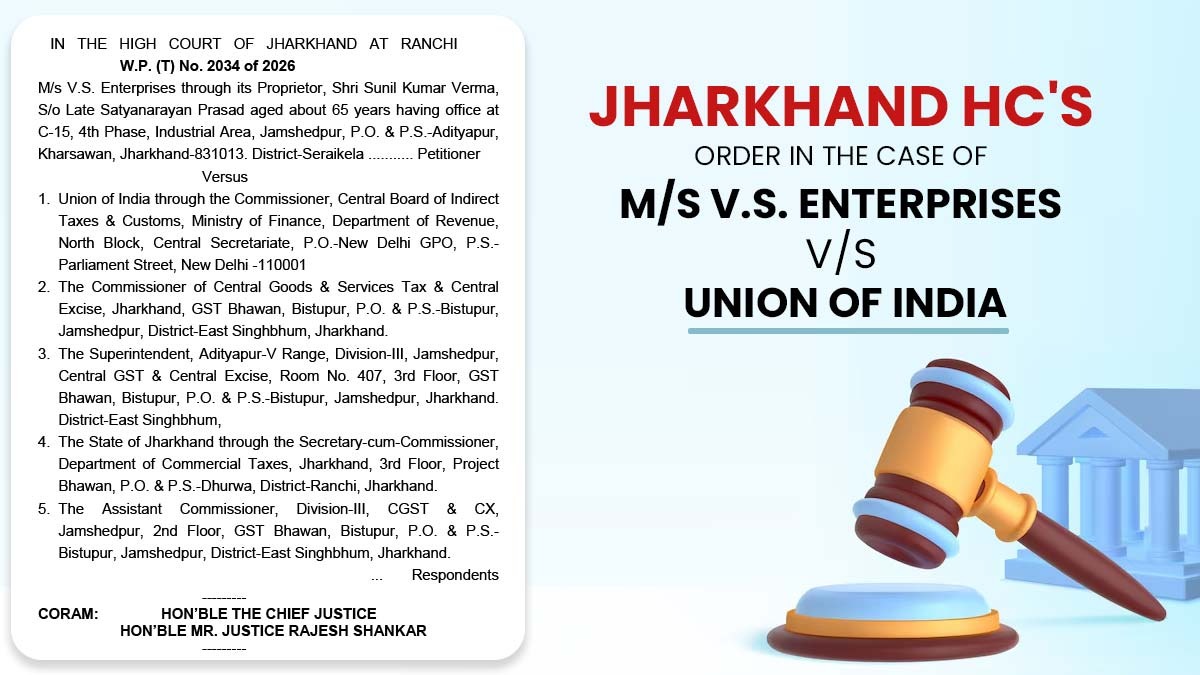
The Jharkhand High Court, in a ruling, held that a writ petition could not be considered where a taxpayer did not submit a regulatory appeal within the specified duration of 120 days under the GST law, and the delay could not be condoned by invoking writ jurisdiction.
A writ petition has been submitted by V.S. Enterprises, through its proprietor, Sunil Kumar Verma, contesting the Order-in-Original dated 26.08.2024 and subsequent recovery proceedings initiated under Sections 73 and 79 of the CGST Act, 2017.
The applicant had a statutory remedy of appeal against the Order-in-Original. The appeal u/s 107 of the CGST Act should be submitted within 90 days, with a further extension of 30 days permitted on showing adequate cause.
No appeal was submitted by the applicant in this period, and instead approached the HC by submitting a writ petition dated 27 February 2026, which was beyond the total allowable duration of 120 days.
The counsel of the applicant said that the impugned orders and recovery proceedings should be set aside and sought relief under Article 226 of the Constitution.
The respondents claimed that the writ petition was not upheld as the applicant had an effective alternative remedy by way of appeal, which was not taken within the specified limitation period.
The Division Bench, including Chief Justice M. S. Sonak and Justice Rajesh Shankar, stated that the applicant had a sufficient statutory remedy but failed to exercise it within the time given under law.
As per the court, the limitation period for filing an appeal is obligatory, and once the extended period of 120 days has lapsed, the delay cannot be condoned.
The Court mentioned that the Supreme Court in Assistant Commissioner (CT) v. Glaxo Smith Kline Consumer Health Care Ltd. and Rikhab Chand Jain v. Union of India has maintained that the writ jurisdiction must not be exercised when a regulatory remedy is available, particularly when the applicant has not taken such a remedy because of his own fault.
Read Also: Gujarat HC: GST Appeal Delays Beyond Limit Cannot Be Condoned Even Under Article 226
Also, the Court said that permitting the writ petitions shall override the statutory scheme and allow the parties to overlook the appellate procedure mentioned under the law.
The Court maintained that as the applicant did not submit the appeal within the specified duration and approached the HC post lapse of limitation, the writ petition cannot be considered. The writ petition has been dismissed by the Court and refused to grant any relief. No costs were charged.
| Case Title | M/s V.S. Enterprises vs Union of India |
| Citation | W.P. (T) No. 2034 of 2026 |
| For the Petitioner | Mr. A.K. Rashidi |
| For the Respondents | Mr. P.A.S. Pati, and Mr. Sahbaj Akhtar |
| Jharkhand High Court | Read Order |


