

Best Way for Filing GSTR-1 | Biz Flow Kit
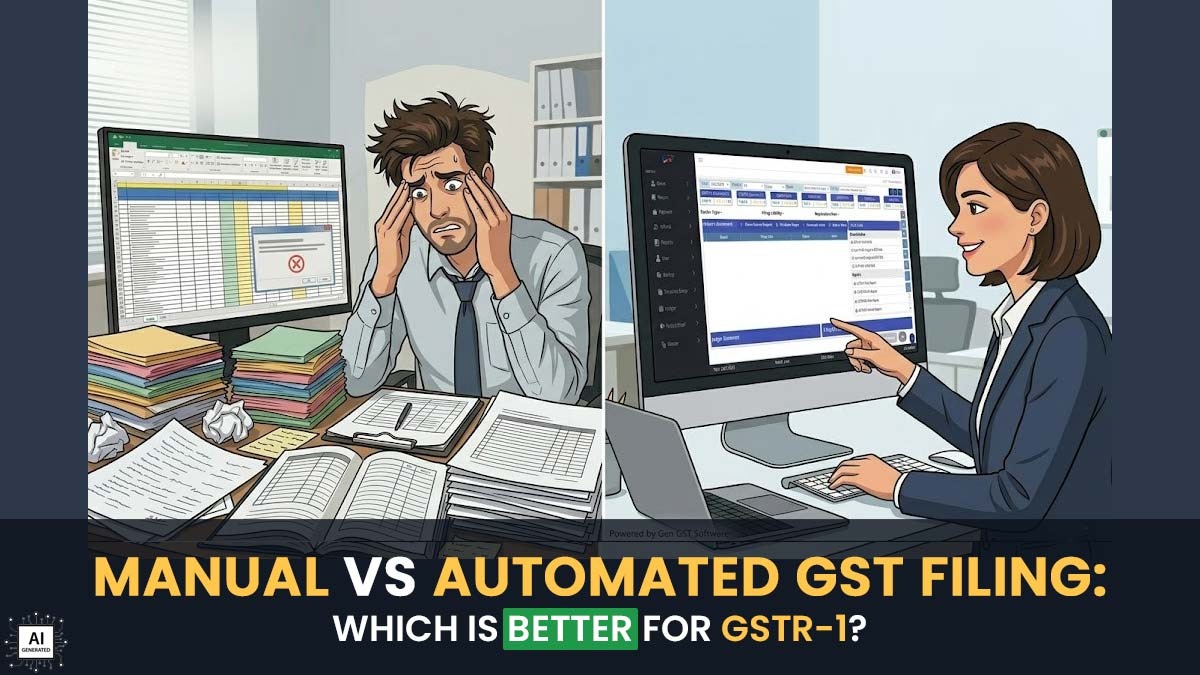
GSTR-1 filing is beyond just putting invoices online. It requires precise sorting, checking, and reporting in different sections. With the expansion of businesses, managing the same procedure manually cannot be easy. GST software facilitates every step of return processing.
What is GSTR-1?
GSTR-1 is a type of form that businesses must fill out every month or every three months. It delivers crucial information about the sales a business has made. It comprises sales to other businesses, sales to individual customers, exports, and any adjustments like credit or debit notes. The form is organised into different sections to present each of these details.
Merits and Challenges of Manual GSTR-1 Filing
Manual filing comprises entering data directly on the GST portal or uploading JSON files.
Merits
- No additional cost
- Suitable for small taxpayers with limited invoices
- Direct control over entries
Challenges
- Repetitive data entry across tables
- Risk of errors in GSTIN, tax rates, or values
- Time-consuming for bulk invoices
- No automatic reconciliation or validation
- Difficult to track missing or duplicate entries
Manual filing becomes difficult when dealing with multiple tables of GSTR-1.
Benefits of Filing GSTR-1 Using GST Software
From data import to final submission, GST software automates the return process.
Benefits
- Bulk import of invoices from Excel/ERP
- Auto-classification into the correct GSTR-1 tables
- Built-in validation checks
- Error detection before filing
- Faster return preparation
- Real-time reports and summaries
Detailed Table-Wise Role of GST Software in GSTR-1
Filing GSTR-1 is not simply about entering sales figures; it requires organising information into various sections, verifying that everything is accurate, and ensuring it aligns with other reports. Each section has its own set of rules, and handling this manually can quickly become complex. Fortunately, GST software simplifies this process by automating tasks such as sorting, calculating, and validating data.
A straightforward comparison of how each section is handled is mentioned below:
Table 1: GSTIN & Return Details
Manual Filing: You manually enter your GSTIN and select the return period. A small mistake, like choosing the wrong month, can lead to filing errors that require corrections.
GST Software: It fetches your GSTIN and locks in the correct return period as per your data, reducing the risk of simple mistakes.
Table 2: Legal/Trade Name
Manual Filing: You verify the legal name each time you file, and although this may seem straightforward, it raises the risk of inconsistencies over time.
GST Software: From the database, it fills in this information automatically, ensuring everything stays consistent without repeated checks.
Table 3: Aggregate Turnover
Manual Filing: You manually calculate total sales from your records, which complicates matching these figures later with another report (GSTR-3B).
GST Software: It calculates the total sales automatically and can reconcile them with GSTR-3B, showcasing any discrepancies promptly.
Table 4: B2B Invoices (Most Important)
Manual Filing: You input each invoice individually, which can lead to errors in GST numbers or tax calculations, and duplicate entries may go unnoticed.
GST Software: It permits bulk uploads from Excel or accounting systems, checks GST numbers in real-time, calculates taxes automatically, and identifies duplicates or missing invoices easily.
Important: How GST Software Manages Invoice Matching & Reconciliation
Table 5: B2C Large Transactions
Manual Filing: You need to identify transactions exceeding ₹2.5 lakh and classify them accurately, as this can affect tax calculations.
GST Software: It determines these transactions as per their values and locations, ensuring accurate classification without additional effort.
Table 6: Export Invoices
Manual Filing: Managing export invoices is complex, particularly due to varying tax regulations and the need to manually input shipping details.
GST Software: It recognises export invoices automatically and manages all shipping needs, ensuring compliance with export rules.
Table 7: B2C Others (Small Transactions)
Manual Filing: You also group small transactions by state manually, which is time-consuming and may result in errors in calculations.
GST Software: It sums up these transactions by state and calculates taxes quickly, saving you hours of work.
Table 8: Nil-Rated, Exempted & Non-GST Supplies
This table fetches all outward supplies where no GST is applicable, along with:
- Nil-rated supplies
- Exempted goods/services
- Non-GST supplies
It is reported state-wise and category-wise (interstate/intrastate).
Manual Filing:
- Identify such transactions from sales data
- Categorise them correctly (nil-rated, exempt, non-GST)
- Separate interstate and intrastate values
- Manually calculate and enter totals
GST Software:
- Identifies nil-rated, exempt, and non-GST transactions
- Categorise them correctly as per tax rates (0%, exempt category, etc.)
- Generates a state-wise summary
- Ensures accurate reporting without missing any entries
- Keeps consistency with books and other returns
Table 9: Credit/Debit Notes
Manual Filing: It is not easy to link notes with the original invoices, and tracking adjustments can be confusing.
GST Software: The software links notes with the original invoices, keeps a history of any revisions, and averts reporting errors.
Table 10: Amendments (B2C Large)
Manual Filing: You need to review past returns to identify and correct mistakes, which can be time-consuming and may result in errors.
GST Software: It furnishes you with easy access to previous data, permitting you to modify or track revisions easily.
Table 11: Advances Received & Adjusted
Manual Filing: Keeping track of advances and reconciling them with future invoices can become complicated, increasing the risk of double reporting.
GST Software: It records advances and adjusts them when generating invoices, keeping a clear record for future use.
Table 12: HSN Summary
Manual Filing: You manually group products and calculate totals for HSN reports, making the process time-consuming and susceptible to mistakes.
GST Software: The software generates HSN summaries, calculating quantities and tax amounts to ensure compliance.
Table 13: Documents Issued
Manual Filing: Tracking invoices and ensuring accurate recording is intricate and sometimes leads to errors.
GST Software: It makes a summary of issued documents, tracks invoice numbers, and averts any duplicates or missing records.
The use of GST software can save time, decrease errors, and ensure precise and compliant filing.
Overall Practical Difference
Manual Filing Reality:
- Repetitive data entry
- Continuous cross-checking
- High dependency on human accuracy
- Difficult with growing data
GST Software Reality:
- One-time data entry or import
- Automatic classification into tables
- Built-in validations and error reports
- Faster filing with higher accuracy
Benefits of GST Software
- Auto Reconciliation: Matches GSTR-1 with GSTR-3B and books
- Error Reports: Identifies issues before filing
- Bulk Upload: Manages thousands of invoices in seconds
- Amendment Tracking: Easily correct previous returns
- Compliance Alerts: Reminds of deadlines and updates
Which One Should You Choose?
- Small businesses (Few Invoices): Manual filing can work
- Growing Businesses: GST software is highly suggested
- Tax Professionals & Enterprises: GST software is necessary
Conclusion: The filing of GSTR-1 includes multiple sections, each requiring precision and accurate categorisation. Although manual filing may appear straightforward at first, it becomes inefficient and risky as the amount of data increases. An advanced GST software automates the filing process and provides detailed, table-by-table guidance, ensuring every aspect of the return is accurately filed.
For businesses looking to save time, minimise errors, and remain compliant, GST software is undoubtedly the superior and more future-ready choice.