
Monthly Bookkeeping Checklist for Businesses: What to Do Every Month Without Missing a Step | Biz Flow Kit
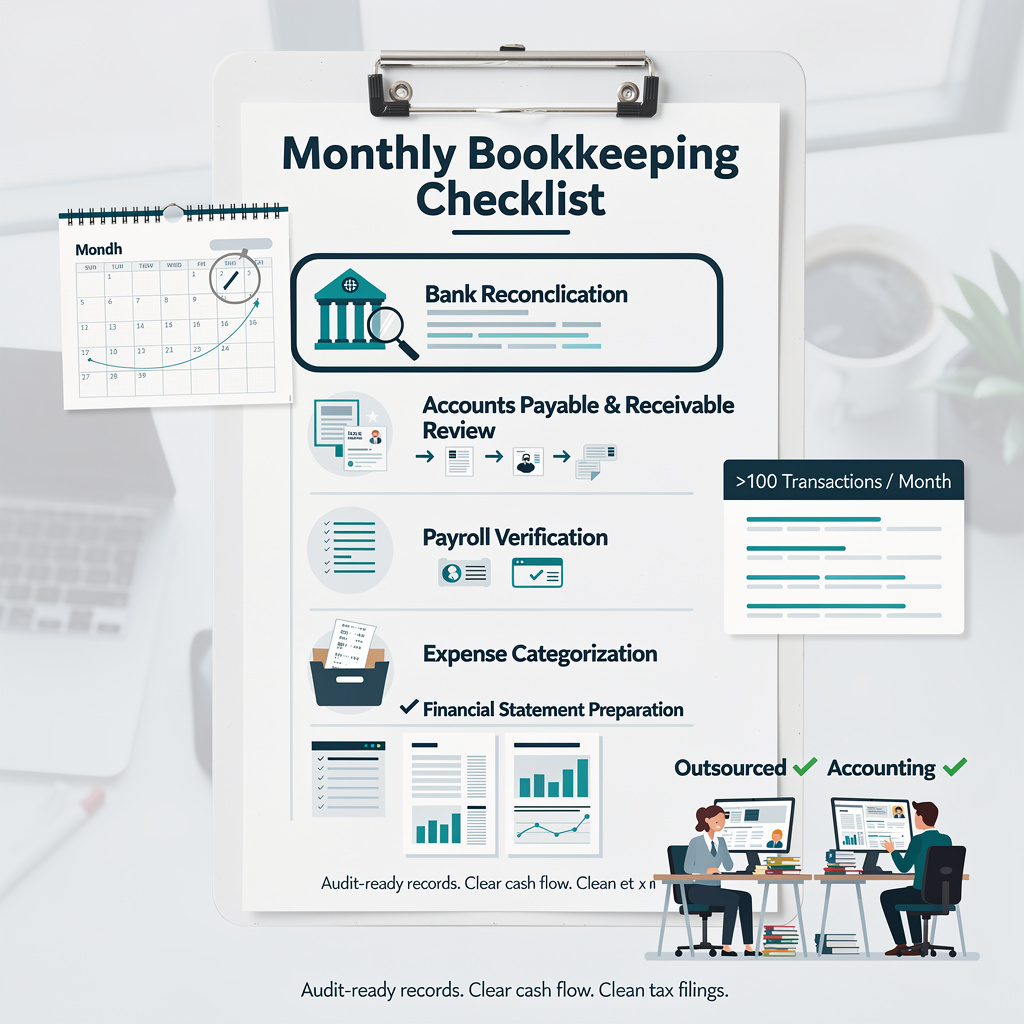
A monthly bookkeeping checklist covers the core finance tasks every business must complete before closing the books, including bank reconciliations, accounts payable and receivable reviews, payroll checks, expense categorization, and financial statement preparation. Done each month, this bookkeeping workflow checklist keeps records audit-ready, cash flow clear, and tax filings clean.
Key Takeaways
- Bank reconciliation is the most important monthly task. Unreconciled accounts hide errors, duplicate payments, and possible fraud.
- Payroll verification is a separate line item on any complete bookkeeper checklist. It is not covered by bank reconciliation alone.
- Businesses managing more than 100 transactions per month benefit from a structured bookkeeping workflow rather than ad-hoc month-end reviews.
- Outsourced accounting teams often close books faster and with fewer errors than in-house staff handling bookkeeping alongside other responsibilities.
Why a Monthly Bookkeeping Checklist Matters More Than Most Businesses Realize
Most bookkeeping problems are not caused by complexity. They are caused by inconsistency.
A transaction missed in week one compounds into a reconciliation error by week three. That error distorts the month-end P&L, which in turn leads to an incorrect tax estimate. By the time anyone notices, the fix takes longer than the original task would have.
According to the U.S. Bureau of Labor Statistics, the median annual pay for bookkeeping and accounting clerks was $49,210 in May 2024. Many businesses carry that cost and still close books late because there is no structured monthly process in place.
Monthly Bookkeeping Checklist: Quick Reference Table
| Task | When in the Month | Primary Owner |
| Collect source documents | Week 1 | Bookkeeper / AP team |
| Bank and credit card reconciliation | Weekly or month-end | Bookkeeper |
| Accounts payable processing | Weekly | AP specialist |
| Accounts receivable aging review | Mid-month and month-end | AR specialist |
| Expense categorization | Ongoing | Bookkeeper |
| Payroll verification | Per payroll cycle | Payroll/bookkeeper |
| Accruals and prepaid adjustments | Month-end | Senior accountant |
| General ledger reconciliation | Month-end | Senior accountant |
| Financial statement preparation | Month-end close | Controller/accountant |
| Period lock and document filing | After final review | Bookkeeper/controller |
What Should Be on a Monthly Bookkeeping Checklist?
- Gather and Organize Source Documents
Before any reconciliation or entry work begins, all source documents need to be in one place. Bank statements, credit card statements, vendor invoices, receipts, payroll records, and loan or lease statements for the month must all be collected first.
Most bank feeds work automatically for businesses that use QuickBooks, Xero, or NetSuite. But just because it auto-feeds doesn’t mean it’s done. You still have to manually match receipts, petty cash, and intercompany transactions before you can do anything else.
- Reconcile Bank and Credit Card Accounts
The most important part of any monthly bookkeeper checklist is bank reconciliation. It makes sure that what the accounting software says matches what really happened at the bank.
Credit card accounts follow the same process. Each charge in the books must match the card statement. Personal charges run through business accounts, one of the most common audit triggers, are caught here if the review is thorough.
- Process and Review Accounts Payable
All invoice documentation from vendors received during the month must be recorded in the books, classified to their proper accounts, and cleared before payment is made.
The bookkeeping AP workflow checklist is as follows: matching invoices to purchase order documents, checking for duplicate invoices, verifying coding against the chart of accounts, and validating payment due dates.
For businesses with higher invoice volumes, the risk is in the backlog. Invoices sitting in an approval queue distort both the payables balance and cash flow projections.
A Vancouver-based mid-market construction firm, OHI, worked with exactly this problem. Their AP process was paper-driven across multiple job sites, with approvals dependent on manual document tracing.
By adopting OHI’s approach to creating an efficient AP workflow system through digitalization and automation, the company reduced its held invoices by half and processed invoices on the same day, achieving a perfect 99.7% accuracy while processing 125 invoices per FTE per day, with costs reduced by 45%. Read the full case study here.
- Review Accounts Receivable and Follow Up on Outstanding Invoices
Unattended open invoices create cash flow issues. Invoices past their due date by more than 30 days have to be monitored rather than merely reported.
The monthly accounts receivable analysis process includes aging reports, identification of overdue invoices, follow-up letters, disputing the amount owed, and validating bad debts before write-off.
- Categorize and Verify All Expenses
Recurring expenses such as software subscriptions, rent, and insurance can be compared with previous periods to identify any unusual items. One-time expenses require supporting documentation for each entry. Any expenses that include both business and personal spending must be properly split before becoming an audit issue.
The chart of accounts should drive categorization. If an expense does not fit cleanly, that is usually a sign that the chart of accounts needs updating, not that the expense should be forced into a close-enough category.

- Verify Payroll
Payroll is the next task. It cannot be automatically addressed through bank reconciliation. Monthly payroll validation confirms whether there were discrepancies in gross salary, tax withholdings, employer-matching amounts, and net pay. Also, all payroll taxes must be deposited on time.
The IRS fines for non-payment range from 2% to 15%, depending on how late the payment is. Monthly payroll tax reconciliation helps prevent these fines, which add up fast. They are completely avoidable through simple monthly processing.
For companies filing Form 941 tax returns, deposit rules are applied on a monthly or semi-weekly basis, depending on the prior lookback period. Understanding and complying with the monthly schedule will save you from receiving notices months later.
For S-Corps specifically, owner-employee compensation must be recorded as salary, not as distributions. This is a specific compliance requirement outlined in IRS Publication 15 that gets missed when payroll is treated as just another bank transaction.
- Post Accruals and Prepaid Adjustments
Expenses should be recognized in the period in which they are incurred, rather than when invoices are received or payments are made.
Common examples of monthly accruals are unpaid vendor invoices, unpaid salaries, interest on outstanding loan balances, and revenue earned but not yet billed. Expenses related to prepayments of costs, including insurance premiums and annual software fees, must be amortized monthly to reflect the actual costs incurred in operations. Failure to do so leads to an income statement that shows inaccurate expenses incurred by the company during the month.
- Reconcile the General Ledger and Prepare Financial Statements
After all entries are posted, the general ledger should be reviewed for unusual balances, unexpected movements, and accounts that have not been updated when they should have been. Balance sheet accounts, including cash, receivables, payables, and loans, need to tie back to supporting schedules or sub-ledgers.
There are three key reports at the end of the monthly closing process: the income statement, balance sheet, and cash flow statement. However, producing these reports is not enough. These reports should be compared to previous months’ figures and budgets. The variance analysis will help explain changes in accounts.
A South Florida residential property management firm managing approximately $15 million in revenues engaged OHI to overhaul exactly this part of their monthly close. Reporting was basic and lacked the granularity that leadership needed to manage expenses or support investor conversations.
OHI reconfigured QuickBooks, added tenant tracking, and delivered a monthly reporting pack covering balance sheet, P&L, and variance commentary. Accounting costs dropped by 45%, resulting in savings of nearly $2,000 per accountant per month.
- Lock the Period and File Supporting Documents
After completing the end-of-month review, the accounting period must be closed in the system to avoid any changes to past figures that would create an incomplete auditing trail. Supporting documents need to be organized consistently each month, as inconsistencies in filing procedures can be a major issue during audits, due diligence, or the annual tax process.
How OHI Supports Monthly Bookkeeping Operations
OHI is a finance and accounting service provider with more than 20 years of experience in providing accounting services to companies in America, the United Kingdom, Canada, and Australia. OHI’s accounting team provides complete monthly bookkeeping for companies in real estate, construction, property management, and even accounting firms.
OHI works across major accounting platforms, including QuickBooks, Xero, NetSuite, Yardi, AppFolio, MRI, RealPage, and Sage. For businesses looking to bring structure to their monthly close without adding headcount, learn more about OHI’s accounting outsourcing services or explore OHI’s real estate accounting capabilities.

FAQ
How long does monthly bookkeeping take for a small business?
A business having between 50 and 100 transactions monthly will require two to three hours for its monthly closing process. Bookkeeping, payroll, or property management will add additional hours.
When should a business outsource its bookkeeping?
When bookkeeping tasks are consistently delayed, when transaction volume exceeds 100 per month, or when in-house staff is managing bookkeeping alongside other roles. Reporting quality that falls short of leadership or investor expectations is another clear signal.
What software is used in a typical bookkeeping workflow checklist?
QuickBooks, Xero, or NetSuite are the common software used by companies. Property management companies often require Yardi, AppFolio, MRI, or RealPage. Monthly checklists remain the same regardless of which software is utilized.