

New Income Tax Rules 2026 & Simplified ITR Forms | Biz Flow Kit
Introduction
The New Income Tax rules 2026 bring important updates to the tax changes in India from 1 April 2026. These rules aim to make tax filing easier, faster, and more accurate for all taxpayers. The government has improved reporting by integrating AIS and TIS with the filing updates.
Under the New Income Tax rules 2026, ITR forms are now more organized and easier to use. Taxpayers lean on pre-filled data, prior permissions, and reduced errors. In general , these updates making Income Tax compliance 2026 clear and well structured.
Overview of New Income Tax Rules 2026
What are the New Income Tax Rules 2026?
The New Income Tax Rules 2026 in India has now restructured and simplified its tax regulations, effective from 1 April 2026 that simplify ITR filing, improve compliance, and enhance reporting through AIS and TIS integration.
The official notification of the updated tax rules is accessible on the Income Tax Department and Ministry of Finance PDF portals. It gives detailed structure, rule changes, and compliance requirements of the same.
Applicability and Effective Date
The tax rules 2026 is now applicable from 1 April 2026. These rules impact individuals, professionals, and businesses across India. Taxpayers must pursue these provisions from FY 2026-27 onwards.
Key Changes in New Income Tax Rules 2026
The New Income Tax rules 2026 introduce significant improvements to simplify tax compliance. The government has restructured ITR forms to make them more organized and user-friendly.
Assessment timelines are brought down to 9 months for faster processing. Simultaneously, stricter disclosure norms and faceless systems refine transparency, accuracy, and overall efficiency in tax administration.
Changes in Reporting and Compliance
Income Tax compliance 2026 updates
The New Income Tax rules 2026 need exhaustive reporting of high-value transactions in ITR.
Compulsory reconciliation with AIS and TIS data prior filing.
Severe objections on mismatches in income, TDS, and deductions.
Intensify the use of pre-filled data for accurate reporting.
PAN and disclosure requirements
PAN is compulsory for specified high-value transactions (banking, property, investments).
Outlining under Statement of Financial Transactions (SFT) expanded.
Lower thresholds for tracking specific financial activities.
Intensify disclosure requirements under the New Income Tax rules 2026.
ITR Forms Update and Filing Process: Income Tax Rules 2026
| Particulars | Old ITR Forms (Up to AY 2025-26) | New ITR Forms (From AY 2026-27) | Legal / Regulatory Change |
| Governing Law | Based on provisions of the Income-tax framework under earlier rules | Aligned with updated Income Tax Rules, 2026 and revised compliance structure | Notified by CBDT under Section 295 for rule-making powers |
| Structure of Forms | Complex and less structured layout | More structured and user-friendly format | Simplification initiative by CBDT to improve compliance |
| House Property Reporting | ITR-1 & ITR-4 allowed reporting of only one house property | Now allows reporting of up to two house properties | Amendment in ITR schema notified by CBDT |
| Capital Gains Reporting | Mandatory detailed bifurcation (short-term vs long-term with multiple conditions) | Reduced complexity; certain bifurcations removed | Relaxation through updated ITR utility format |
| Address Details | Only one address could be provided | Introduction of secondary address field | Enhanced disclosure requirement in notified forms |
| Pre-filled Data (AIS/TIS) | Limited pre-filled data; manual entry required | Expanded and more accurate auto-filled data from AIS/TIS | Strengthening of Section 285BB (Annual Information Statement) |
| Disclosure for NRIs | Basic disclosure for presumptive taxation | Separate and detailed disclosures required for NRIs | Enhanced reporting aligned with Section 44ADA/44AD updates |
| High-Value Transactions | General reporting, limited cross-verification | Detailed disclosure aligned with AIS data | Linked to Section 285BA (Statement of Financial Transactions) |
| Foreign Assets Reporting | Required but less integrated | More structured and stricter reporting fields | Governed by Schedule FA and Black Money Act compliance |
| F&O / Business Income | No specific structured disclosure for derivatives | Mandatory separate reporting of F&O transactions | Improved reporting under business/professional income provisions |
| Deduction Reporting (80G, etc.) | Basic entry without detailed breakdown | More granular reporting with validation checks | Strengthening compliance under Chapter VI-A |
| Form Selection Clarity | Confusion in choosing correct ITR form | Clearer eligibility criteria and instructions | CBDT simplification and guidance updates |
| Error Reduction & Validation | Higher chances of errors due to manual entry | Built-in validations and system checks | Tech-driven compliance improvements |
| Digital Integration | Partial integration with tax systems | Fully integrated with AIS, TIS, and faceless assessment system | Part of e-governance and faceless scheme reforms |
Step-by-step overview: ITR Filing Process 2026 India
You can refer this step-by-step overview of the ITR Filing Process 2026 (India) for easy easy explanations:
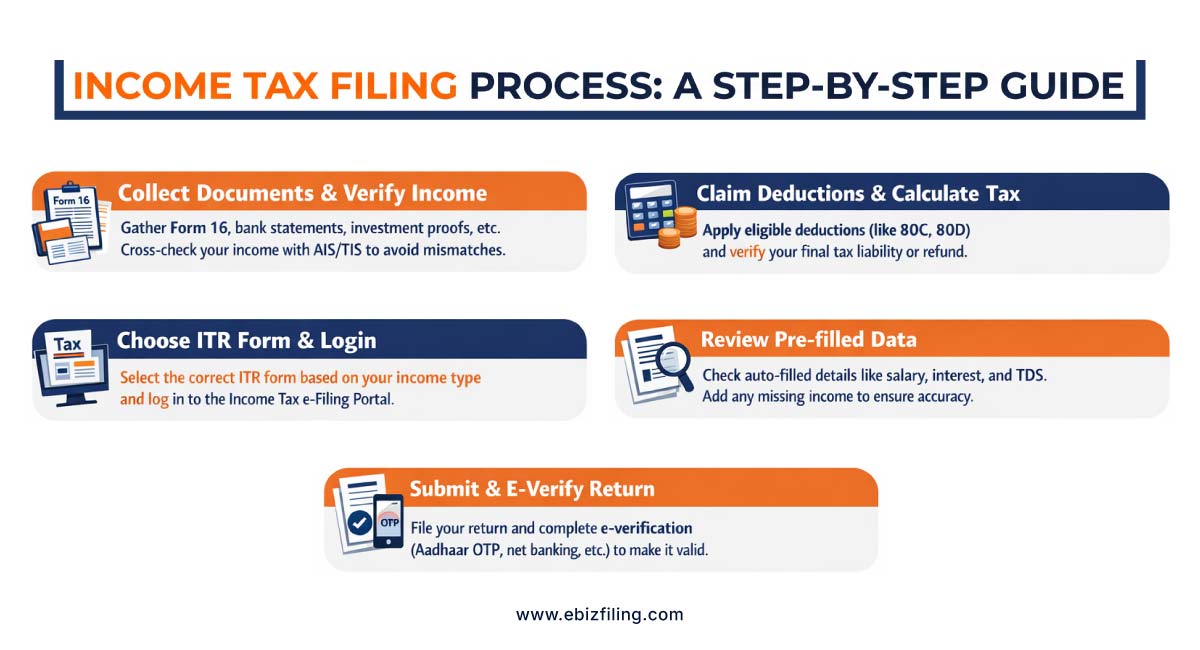
Follow the income tax filing process step-by-step under New Income Tax rules 2026 for accurate return submission.
Why Choose Ebizfiling for ITR Filing in 2026?
- You can start by sharing your income and required documents with our team.
- Next, we verify your details with AIS and TIS data.
- Based on your profile, the correct ITR form is selected.
- Your return is then filed with proper checks and accuracy.
- Lastly, we complete e-verification and assist with follow-ups.
Get started with Ebizfiling today for stress-free Online ITR filing.
Conclusion
The New Income Tax rules 2026 structure tax filing and improve overall compliance. They enhance reporting and make it more specific and reduce errors through digital integration.
The updated rules and filing the essentials on time can help the taxpayers in avoiding penalties and engage in a smooth process. These initials adaptations will help you stay compliant and manage all your taxes more efficiently.
Suggested read:
Income Tax Rules major renumbering of forms
Top changes impacting salaried taxpayers
Frequently Asked Questions
1. What makes the New Income Tax Rules 2026 different from previous rules?
The New Income Tax Rules 2026 focus on easier and faster processing with stronger digital integration. These changes streamline tax filing, improve transparency, and help taxpayers better understand updated compliance requirements.
2. Where can taxpayers access the official PDF of the new rules?
Taxpayers can download the official rules from the Income Tax Department or Ministry of Finance website. The PDF includes complete details of the new provisions, compliance requirements, and rules applicable from April 2026.
3. How does Ebizfiling ensure accuracy in ITR filing under the New Income Tax Rules 2026?
Ebizfiling follows a structured verification process by matching income, TDS, and deductions with AIS and TIS data. This ensures accurate disclosures, minimizes mismatches, and reduces the chances of notices or filing errors.
4. What changes have been made in income reporting requirements?
The new rules require more detailed reporting of income, including high-value transactions and investments. Taxpayers must reconcile their income details with AIS and TIS to avoid discrepancies and compliance issues.
5. Are there any changes in tax calculation or rates?
The major changes focus on compliance and reporting improvements rather than tax rates. The tax calculation process is now more digitized, ensuring accurate and real-time updates, while most tax rates remain largely unchanged.
6. How does AIS and TIS impact ITR filing under the new rules?
AIS and TIS provide pre-filled income data, making it important for taxpayers to verify and match their details before filing. This helps ensure accurate filing and reduces the chances of errors or tax notices.
7. Why should you choose Ebizfiling for Income Tax compliance 2026?
Ebizfiling simplifies Income Tax compliance by tracking updates, handling documentation, and ensuring accurate filing. With expert guidance and timely processing, it helps avoid penalties and ensures stress-free compliance.
8. How has the ITR filing process improved in 2026?
The ITR filing process in 2026 is more digital and automated. With real-time validation and reduced manual intervention, filing has become faster, more efficient, and user-friendly.
9. What common mistakes should taxpayers avoid under the new rules?
Taxpayers should avoid mismatches with AIS/TIS data, incorrect deductions, and missing income details. Proper verification before submission is essential to prevent penalties, delays, or notices.
10. Who should seek professional help for ITR filing in 2026?
Individuals with multiple income sources, business income, or complex financial transactions should consider professional assistance. Ebizfiling offers expert ITR filing services aligned with the latest rules for accurate and compliant submissions.