
Supreme Court Upholds GST Officers’ Arrest Powers, Declares Section 69 Constitutional | Biz Flow Kit
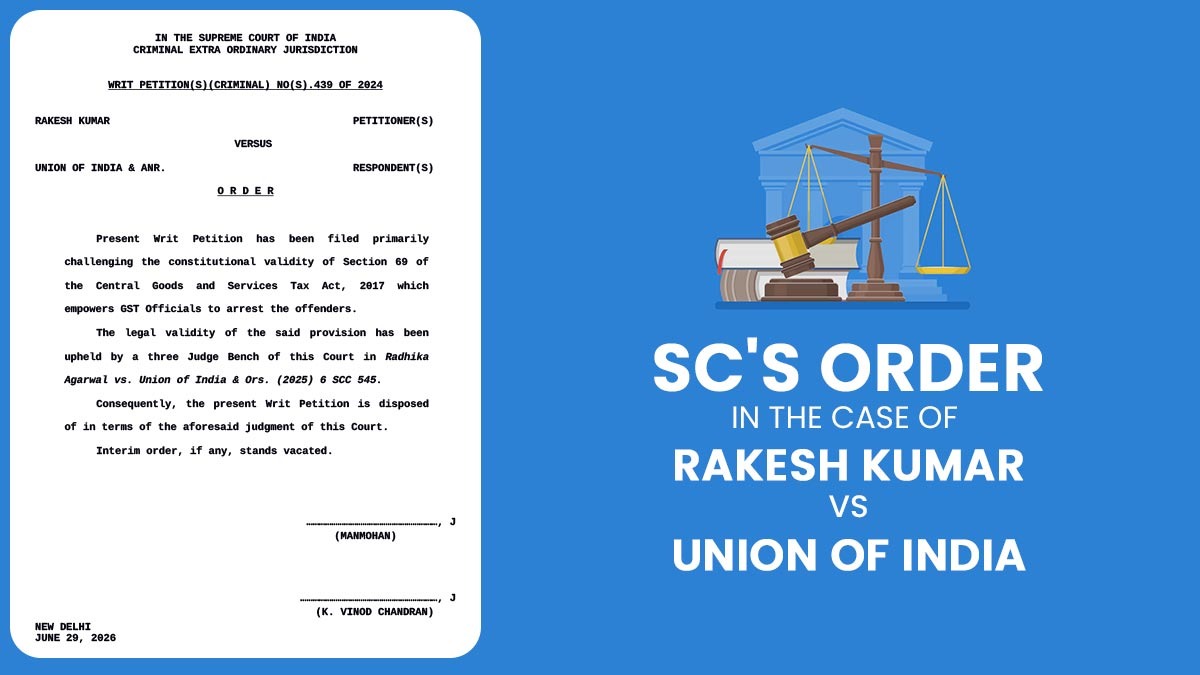
The Supreme Court has disposed of a writ petition contesting the constitutional validity of Section 69 of the Central Goods and Services Tax (CGST) Act, 2017, which authorises GST officers to arrest persons charged with specified GST offences.
The bench of Justice Manmohan and Justice K. Vinod Chandran has said that the issue is no longer res integra, as a three-judge Bench had already upheld the validity of the provision in Radhika Agarwal v. Union of India & Ors. (2025) 6 SCC 545.
The writ petition asked for a declaration that Section 69 of the CGST Act is unconstitutional. A Division Bench, including Justice Manmohan and Justice K. Vinod Chandran, heard the case and delivered its order on June 29, 2026.
Section 69 of the CGST Act authorises the commissioner to order the arrest of a person when there are grounds to believe the individual has committed specific offences under the Act, particularly those involving tax evasion or fraudulent claims of GST ITC. The provision has been constitutionally challenged because it grants extensive powers to GST authorities.
The applicant questioned the legality and constitutional validity of this regulatory authority. Although at the time of hearing, the Supreme Court observed that the constitutional issue had already been conclusively decided by a larger Bench.
The Bench said that a three-judge Bench of the Supreme Court in Radhika Agarwal v. Union of India & Ors. had maintained the constitutional validity of Section 69 of the CGST Act. As the legal issue stood settled, the Court did not find any reason to independently analyse the challenge raised in the present petition.
Therefore, the Court disposed of the writ petition in accordance with the earlier judgment. The Supreme Court had disposed of the case and asked that any interim order granted in the pendency of the proceeding shall stand vacated. Subsequently, all pending applications were disposed of.
| Case Title | Rakesh Kumar Vs Union of India |
| Case No. | Writ Petition(S)(Criminal) No(S) 439 of 2024 |
| For Petitioner | Mr Praveen Kumar Jha, Mr R.p.singh, Mr Ashok Kumar Jha |
| Supreme Court Order | Read Order |