Presumptive Business or Normal Business While Filling of Your ITR | Biz Flow Kit
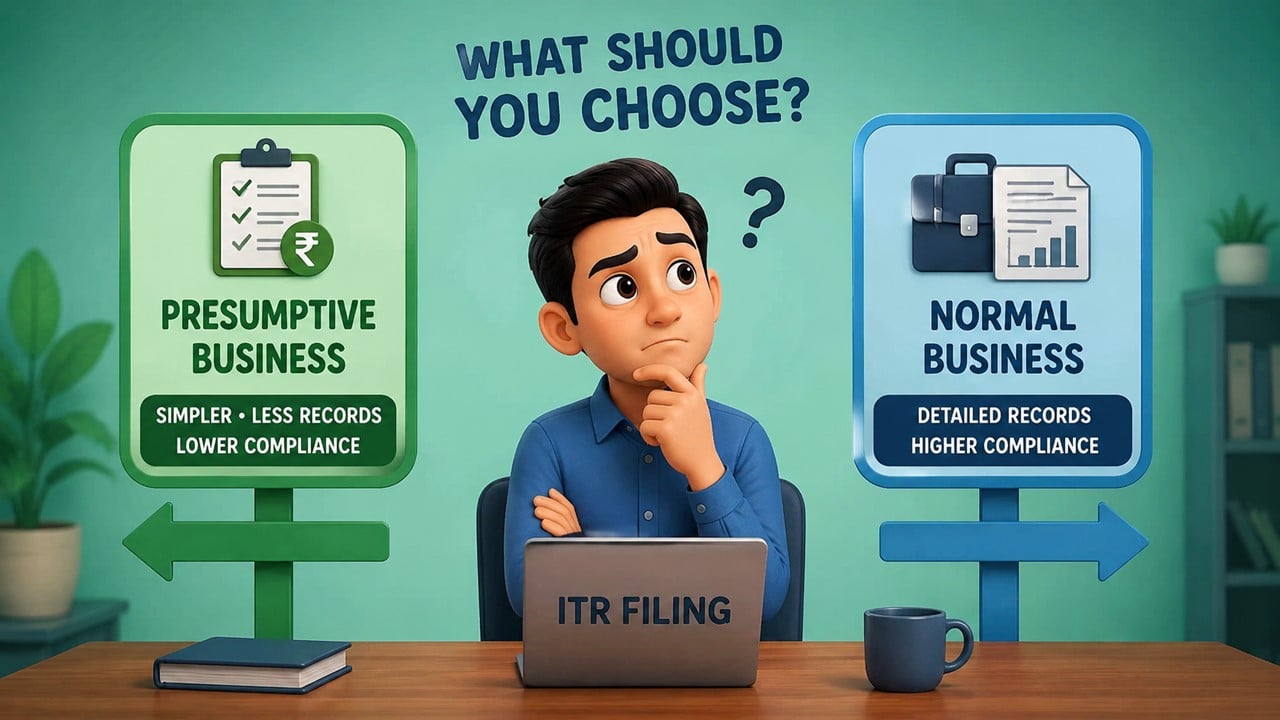
What You Should Choose: Presumptive Business or Normal Business While Filling of Your ITR
Introduction
As the due date for ITR is approaching its important to decide for an Individual or HUF running any Business or Profession to declare their profits on presumptive basis or under normal provision of the act. As there are pros & cons for both of the methods which every taxpayer should know.

Let’s decode it
Presumptive Taxation Legal Provisions
|
Section  |
Scheme | Eligible Assessee | Turnover / Gross Receipt Limit |
| 44AD | Presumptive for Business | Resident Individual, HUF, Partnership Firm (not LLP) |
Up to ₹3 Cr (if cash receipts ≤ 5%) Up to ₹2 Cr otherwise |
|
44ADA |
Presumptive for Professionals | Resident Individual / Partnership Firm specified professions | Up to ₹75 Lakh (if cash ≤ 5%) Up to ₹50 Lakh otherwise |
| 44AE | Transport Operators | Any assessee owning ≤ 10 goods carriages |
Per-vehicle deemed income |
Normal Computation Key features
Under the normal scheme, the business income is computed under the head Profits and Gains of Business or Profession in accordance with Sections 28 to 44 some of the key points are as below
- Maintenance of books of accounts as prescribed under Section 44AA and Rule 6F.
- Tax audit u/s 44AB where total sales, turnover, or gross receipts exceed ₹1 Crore (₹10 Crore if cash transactions ≤ 5%) for business, or ₹50 Lakh for specified professions.
- Allowance of all expenditures under Sections 30 to 37 including rent, repairs, depreciation u/s 32, scientific research expenditure u/s 35, and other business expenses.
- Set-off and business losses can be carried forward for 8 assessment years (Section 72)
Pros & Cons of Presumptive Taxation
|
Pros |
Cons |
| No mandatory books of accounts u/s 44AA |
Deemed income irrespective of actual profit / loss |
|
Exemption from audit u/s 44AB (if within limit) |
Loss-making businesses end up paying tax on notional income |
| Ideal for small taxpayers |
Cannot carry forward business loss under this scheme |
|
Simplified ITR-4 filing reduced compliance burden |
Opt-out triggers 5-year lock-in from re-adopting the scheme |
| Liquidity benefit no quarterly advance tax payments |
Deductions u/s 30 to 38 deemed allowed & no further claims |
|
Ideal for small taxpayers with thin administrative setup |
Depreciation deemed allowed |
| Reduces chances of scrutiny on expense claims |
Not available to companies, LLPs, or non-residents |
Pros & Cons of Normal Business
|
Pros |
Cons |
| Claim actual deductions u/s 30 to 37 including depreciation |
Mandatory books of accounts u/s 44AA |
|
Carry forward and set off of business losses u/s 72 |
Tax audit u/s 44AB if turnover exceeds threshold |
| Beneficial where actual profit margin is below 6%/8% |
Quarterly advance tax instalments |
|
Suitable for capital-intensive businesses with high depreciation |
Higher compliance and professional costs |
| No restriction on entity type available to companies, LLPs |
Greater scrutiny risk on expenditure claims |
|
Beneficial for businesses with genuine losses |
Complex computation and record maintenance for Scrutinies |
How to decide?
Let’s take some scenarios upon which one can decide what to choose
|
Scenario |
Recommended Option | Key Reason |
| Actual net profit > 6% / 8% of turnover | Presumptive (44AD) |
Tax savings + zero compliance cost |
|
Actual net profit < 6% / 8% of turnover |
Normal | Lower tax liability on actual income |
| Business has genuine losses | Normal |
Carry forward benefit u/s 72 |
|
Capital-intensive high depreciation asset base |
Normal | Depreciation claim reduces taxable income substantially |
| Small trader, turnover < ₹2 Cr, high margin | Presumptive (44AD) |
Simplicity and tax audit exemption |
|
Professional (doctor, lawyer, architect, etc.) |
Presumptive (44ADA) | Only 50% of gross receipts taxed |
| Company or LLP | Normal |
Presumptive not available |
|
Transport operator (≤ 10 vehicles) |
Presumptive (44AE) | Fixed per-vehicle deemed income |
| If losses expected in early years | Normal |
Loss carry forward critical for future offset |
Conclusion
Hence its very crucial to decide whether to declare profits under which manner to maximize the Tax savings & minimizing compliance as upon which the selection of ITR is also dependent which forms crucial part for verification.
As wrong ITR form leads to defective return & un-necessary compliance burden hence one should compare all pros & cons before declaring the business or profession income.
Join StudyCafe Membership. For More details about Membership Click Join Membership Button
In case of any Doubt regarding Membership you can mail us at [email protected]
Join Studycafe’s WhatsApp Group or Telegram Channel for Latest Updates on Government Job, Sarkari Naukri, Private Jobs, Income Tax, GST, Companies Act, Judgements and CA, CS, ICWA, and MUCH MORE!”