GST Inclusive vs Exclusive: Reverse Tax Splitting, Formulas & Compliant Invoicing in FY 2026-27
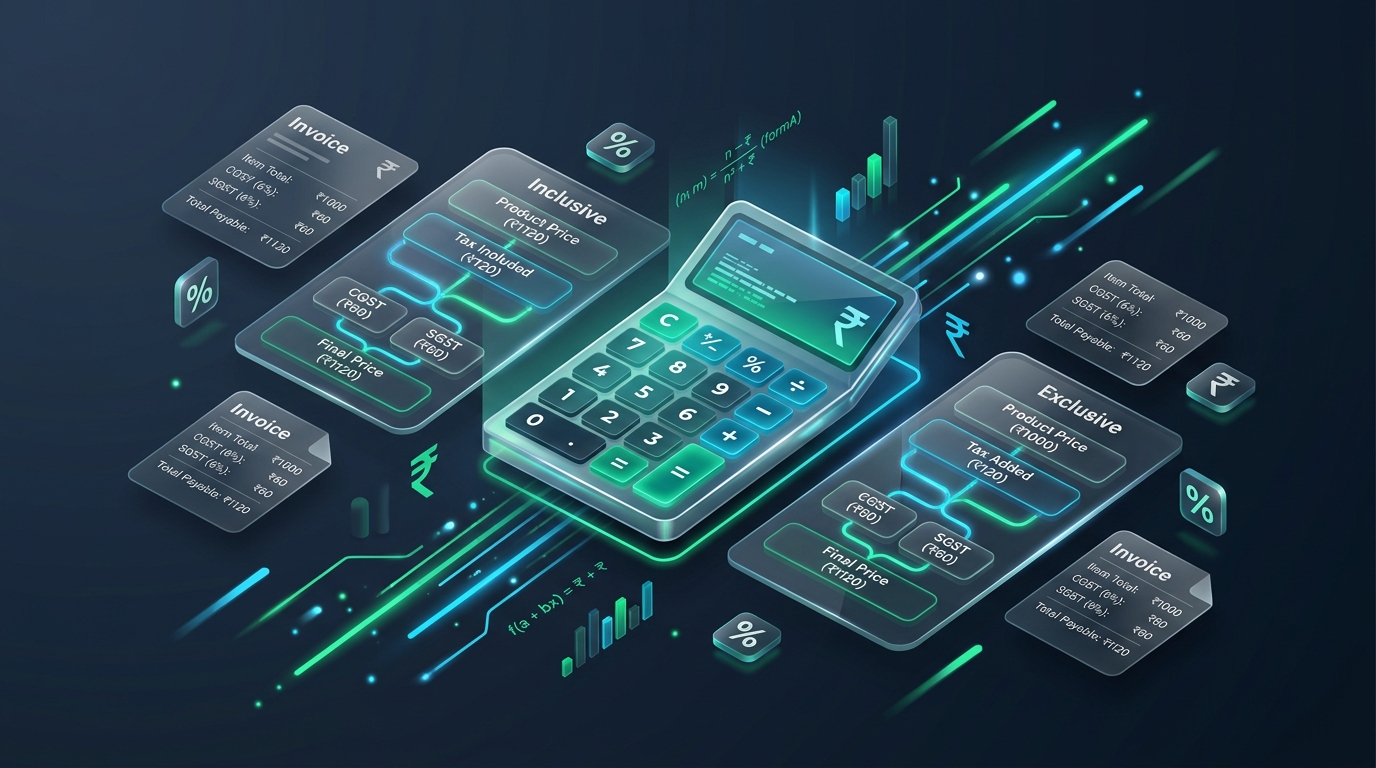
Whether you are a freelance consultant issuing your first monthly retainer invoice, an e-commerce seller pricing products on digital marketplaces, or a growing business negotiating supply contracts, one pricing question dictates your real margins: Is this rate GST inclusive or GST exclusive?
Failing to distinguish between inclusive and exclusive pricing does not merely cause awkward commercial renegotiations—it frequently triggers serious statutory reporting errors. Under the Central Goods and Services Tax (CGST) Act, miscalculating the taxable value of supply can lead to under-collection of tax, penalties under Section 73 or 74, or the rejection of Input Tax Credit (ITC) for your B2B buyers under Section 16.
In this comprehensive guide, we unpack the exact mathematical mechanics of forward and reverse GST calculation, examine statutory invoicing mandates under Rule 46 and Section 33, explain the mathematical trap that costs businesses thousands of rupees, and provide worked examples across every primary GST slab for FY 2026–27.
1. GST Exclusive vs. Inclusive: What Is the Difference?
At its core, the distinction between GST exclusive and GST inclusive pricing lies in whether the quoted price already absorbs the indirect tax obligation:
- GST Exclusive Pricing: The quoted figure represents solely the taxable base value of the goods or services. Statutory Goods and Services Tax (CGST + SGST or IGST) is added on top of this figure at the applicable rate when invoicing. B2B commercial contracts in India are predominantly quoted on a GST-exclusive basis.
- GST Inclusive Pricing: The quoted figure is the final gross consideration payable by the buyer. It already bundles both the underlying taxable value and the government’s indirect tax component. In India, retail consumer sales, restaurant billing, Maximum Retail Prices (MRP), and consumer-facing SaaS pricing are typically inclusive of all taxes.
Statutory Mandate Section 33 of the CGST Act
Section 33 of the CGST Act creates a mandatory legal presumption: unless the contrary is proved, every person who makes a supply of taxable goods or services must prominently indicate the exact amount of tax in all tax invoices and commercial documents. Even if you quote an all-inclusive price, your final tax invoice must clearly isolate and display the taxable base value and the exact tax charged.
2. The Mathematical Formulas
Many business owners and bookkeepers make fatal rounding or conceptual errors when reversing taxes. Here are the precise algebraic formulas governing both methodologies:
A. Exclusive GST Calculation (Forward Addition)
When you have the net base price and need to compute the tax amount and total invoice value:
GST Amount = (Base Taxable Value × GST Rate) ÷ 100
// Step 2: Total Gross Invoice
Total Invoice Amount = Base Taxable Value + GST Amount
B. Inclusive GST Calculation (Reverse Tax Splitting / Back-Calculation)
When you have a gross, all-inclusive price and need to extract the underlying taxable value and tax component:
Base Taxable Value = (Total Inclusive Amount × 100) ÷ (100 + GST Rate)
// Step 2: Derive GST Portion
GST Amount = Total Inclusive Amount − Base Taxable Value
= (Total Inclusive Amount × GST Rate) ÷ (100 + GST Rate)
3. The “Direct Subtraction” Trap: The Error That Destroys Margins
The single most widespread calculation blunder made by small businesses is attempting to back-calculate GST by simply deducting the percentage directly from the gross inclusive figure.
Caution The Fatal Direct Subtraction Mistake
Suppose you agree to an all-inclusive freelance contract of ₹1,18,000 subject to 18% GST.
- The Incorrect Calculation: ₹1,18,000 × 18% = ₹21,240. The contractor records Base Value = ₹1,18,000 − ₹21,240 = ₹96,760.
- Why this is mathematically disastrous: If the taxable base were indeed ₹96,760, then 18% GST on that base would only be
₹96,760 × 0.18 = ₹17,416.80. The resulting invoice total would be ₹114,176.80—creating an immediate ₹3,823.20 cash mismatch! - The Correct Reverse Split:
Base Value = (₹1,18,000 × 100) ÷ 118 = ₹1,00,000.00
GST Amount = ₹1,18,000 − ₹1,00,000 = ₹18,000.00(CGST ₹9,000 + SGST ₹9,000)
Because the tax was originally added to a smaller base (100%), the tax constitutes a smaller fraction of the resulting gross total (100 + Rate). For an 18% slab, GST is actually 15.2542% of the gross amount, not 18%!
4. Quick Multipliers Across Standard Indian GST Slabs
To perform instant reverse calculations on a standard calculator or in custom spreadsheet formulas, use these statutory factors for FY 2026–27:
| GST Slab | Base Value Multiplier | Tax Fraction of Gross | Intra-State Split | Inter-State Allocation |
|---|---|---|---|---|
| 5% | Gross ÷ 1.05 | 4.7619% (5/105) | CGST 2.5% + SGST 2.5% | IGST 5.0% |
| 12% | Gross ÷ 1.12 | 10.7143% (12/112) | CGST 6.0% + SGST 6.0% | IGST 12.0% |
| 18% | Gross ÷ 1.18 | 15.2542% (18/118) | CGST 9.0% + SGST 9.0% | IGST 18.0% |
| 28% | Gross ÷ 1.28 | 21.8750% (28/128) | CGST 14.0% + SGST 14.0% | IGST 28.0% |
5. Verified Worked Example: Intra-State vs. Inter-State Billing
Consider an Indian software consulting firm located in Bengaluru, Karnataka, delivering digital engineering services:
Scenario 1: Intra-State Supply (Client located in Bengaluru, Karnataka)
- Total Agreed Fee (Inclusive of 18% GST): ₹2,36,000.00
- Step 1: Calculate Taxable Base Value:
Base = ₹2,36,000 ÷ 1.18 = ₹2,00,000.00 - Step 2: Calculate Total GST:
Total GST = ₹2,36,000 − ₹2,00,000 = ₹36,000.00 - Step 3: Apportion Intra-State Taxes:
Central Tax (CGST @ 9%) = ₹36,000 ÷ 2 = ₹18,000.00
State Tax (SGST @ 9%) = ₹36,000 ÷ 2 = ₹18,000.00 - Step 4: Invoice Total: ₹2,00,000 (Base) + ₹18,000 (CGST) + ₹18,000 (SGST) = ₹2,36,000.00.
Scenario 2: Inter-State Supply (Client located in Mumbai, Maharashtra)
- Total Agreed Fee (Inclusive of 18% GST): ₹2,36,000.00
- Step 1: Calculate Taxable Base Value:
₹2,00,000.00 - Step 2: Apportion Inter-State Taxes:
Integrated Tax (IGST @ 18%) = ₹36,000.00 - Step 3: Invoice Total: ₹2,00,000 (Base) + ₹36,000 (IGST) = ₹2,36,000.00.
Need to Split GST Inclusive or Exclusive Rates Instantly?
Calculate base amounts, CGST/SGST breakdowns, and inter-state IGST splits across all standard rates with zero manual math or sign-ups.
6. Mandatory Invoicing Requirements under Rule 46 of CGST Rules
Generating an invoice with only the gross total and a generic note stating “inclusive of GST” violates the CGST Act and risks input tax credit disallowance during your buyer’s statutory tax audit. Under Rule 46, every tax invoice issued by a registered taxpayer must contain:
- Name, address, and GSTIN of the supplier.
- Consecutive serial number not exceeding 16 characters, unique for each financial year.
- Date of issuance.
- Name, address, and GSTIN / UIN of the recipient (if registered for GST).
- Harmonised System of Nomenclature (HSN) code for goods or Service Accounting Code (SAC) for services.
- Description of goods or services.
- Total value of supply of goods or services.
- Taxable value of supply (the base value after trade discounts or abatements).
- Rate of tax (broken down into Central tax, State tax, Integrated tax, or Cess).
- Amount of tax charged in respect of taxable goods or services.
- Place of supply along with the name of the destination State in the case of inter-State transactions.
- Signature or digital signature of the supplier or authorized representative.
7. Rounding-Off Protocols (Section 170 of CGST Act)
Odd contract figures often produce recurring decimal points (e.g., ₹1,499 inclusive of 18% yields a base of ₹1,270.33898…). How should this be handled on tax invoices?
Section 170 of the CGST Act specifies the statutory rounding-off mechanism:
- Any amount of tax, interest, penalty, fine, or refund must be rounded off to the nearest rupee.
- Amounts containing fifty paise or more (≥ ₹0.50) are rounded upward to the next rupee.
- Amounts containing less than fifty paise (< ₹0.50) are disregarded.
Best Practice: Always round off at the line-item level for tax calculation and record the balancing adjustment in a dedicated “Round-Off” ledger line on the invoice.
8. Related Compliance Tools from BizFlowKit
Maintain complete fiscal and compliance oversight with our companion utilities:
- Avoid ₹50/day filing penalties: Monitor state-by-state QRMP schedules and statutory due dates with the BizFlowKit GST Due Date Checker.
- Audit-proof MSME payouts: Calculate compound interest obligations and Section 43B(h) deadlines with the MSME Delayed Payment Interest Calculator.
- Structure tax-efficient payroll: Compare New vs. Old Tax Act take-home income using the Salary Take Home Calculator.
Frequently Asked Questions (FAQs)
1. Can a B2B buyer claim Input Tax Credit (ITC) on a GST-inclusive invoice?
Yes, provided the invoice complies with Rule 46. The invoice must clearly specify the taxable value, the GST rate, and the exact tax amount (CGST/SGST or IGST) along with the buyer’s valid GSTIN. If a supplier issues a retail bill or payment receipt that only lists a single gross figure without a statutory tax breakup, the buyer cannot substantiate an ITC claim under Section 16(2).
2. Why does deducting 18% from the inclusive amount result in the wrong base value?
Because percentage addition and subtraction are not symmetrical. If a base of ₹100 is increased by 18%, the total is ₹118. In that ₹118 total, the ₹18 tax accounts for 18 ÷ 118 = 15.2542% of the gross amount. If you subtract 18% of ₹118 (₹21.24), you artificially depress your taxable base to ₹96.76, shortchanging your revenue and creating an accounting mismatch.
3. Is quoting GST-inclusive prices legal for B2B transactions in India?
Yes, commercial parties are free to negotiate all-inclusive contract prices. However, under Section 33 and Rule 46 of the CGST Act, when the supplier generates the statutory tax invoice, the tax amount and taxable base must be back-calculated and explicitly itemized.
4. How are trade discounts treated in GST calculations?
Under Section 15(3) of the CGST Act, trade discounts given before or at the time of supply and duly recorded on the invoice are deducted from the gross value before calculating GST. If a discount is granted post-sale, it can only reduce taxable turnover if established in terms of an agreement entered into before or at the time of supply and linked to relevant invoices via a credit note.
5. Does reverse charge (RCM) change the inclusive/exclusive calculation?
Under Reverse Charge Mechanism (Section 9(3) / 9(4)), the recipient is liable to pay tax directly to the government. Therefore, the supplier cannot charge or include GST on their invoice; the invoice is issued for the base taxable value only, marked with a declaration that tax is payable under RCM.
Test Your Numbers on BizFlowKit
Calculate GST rates, verify statutory filing deadlines, and prevent late fee penalties with 100% client-side privacy.
GST Calculator Online (Inclusive & Exclusive)
Compute accurate CGST, SGST, IGST splits and statutory rate brackets instantly with exportable tax breakup.