Income Tax Act Overhaul
Executive Summary: The Unified Capital Gains Tax Framework
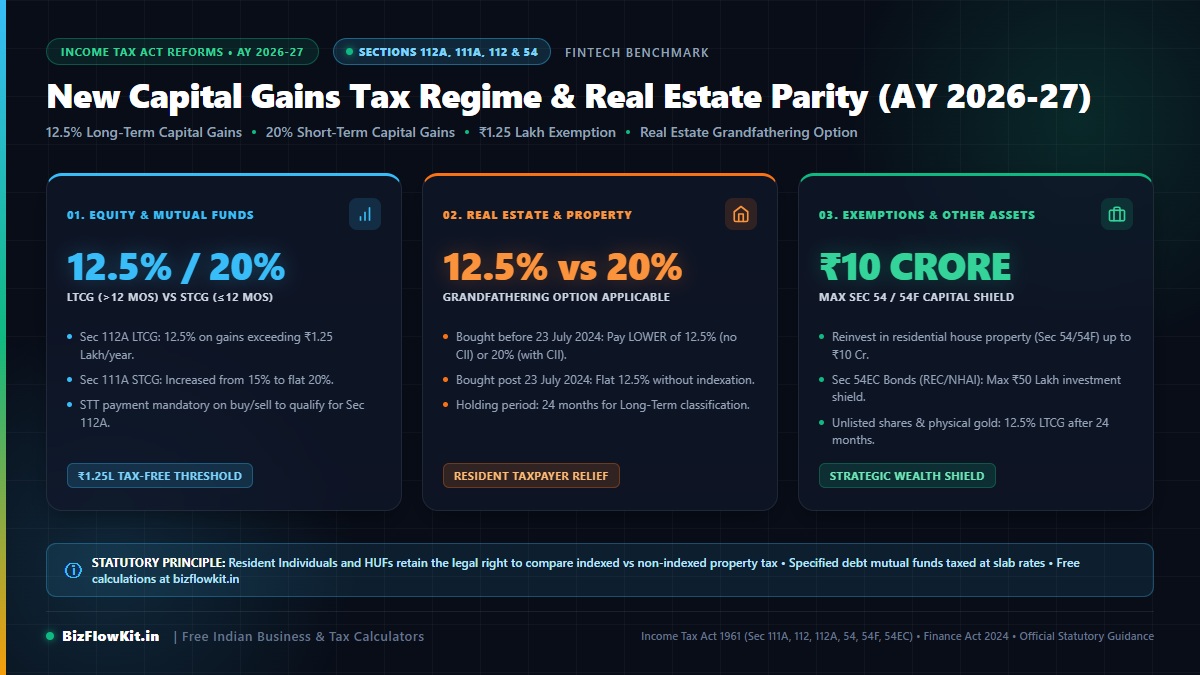
For Assessment Year 2026-27 (Financial Year 2025-26), India’s capital gains taxation underwent its most extensive structural overhaul in over two decades. The regime collapses a fragmented multi-rate system into a clear two-tier structure: 12.5% Long-Term Capital Gains (LTCG) across all major financial and non-financial assets, and 20% Short-Term Capital Gains (STCG) on listed equities.
Crucially for property owners, a special statutory grandfathering clause protects resident individuals and HUFs selling real estate acquired before 23 July 2024, granting them the legal right to compute tax under both the 12.5% unindexed regime and the 20% indexed regime, paying whichever amount is lower. In listed equities, the annual tax-free threshold under Section 112A is permanently raised to ₹1,25,000.
1. The Simplified Two-Tier Holding Period Architecture
Historically, Indian income tax recognized three different holding periods (12 months, 24 months, and 36 months) across various asset classes, creating immense litigation. For AY 2026-27, the legislature harmonized holding periods into strictly two categories under Section 2(42A):
- 12 Months Threshold (Listed Financial Assets): Equity shares listed on a recognized stock exchange in India, units of equity-oriented mutual funds, units of Business Trusts (REITs and InvITs), and Zero-Coupon Bonds qualify as long-term capital assets if held for more than 12 months.
- 24 Months Threshold (All Other Capital Assets): Immovable property (land, residential houses, commercial buildings), unlisted shares (startups and private limited companies), physical gold, jewelry, and international mutual funds qualify as long-term assets if held for more than 24 months. (The old 36-month bucket has been completely eradicated).
- Zero Holding Period Exemption (Specified Debt Mutual Funds): Under Section 50AA, units of specified mutual funds where not more than 35% is invested in equity shares of domestic companies are deemed short-term capital gains and taxed at normal applicable slab rates, irrespective of holding duration.
2. Listed Equities: Section 112A LTCG vs. Section 111A STCG
For stock market investors and retail mutual fund unitholders, the amendments to Section 112A and Section 111A present a dual adjustment:
A. Enhanced Section 112A Exemption (₹1.25 Lakh)
Under Section 112A, Long-Term Capital Gains arising from the transfer of an equity share in a company, a unit of an equity-oriented fund, or a unit of a business trust are taxed at 12.5% (increased from 10%). However, Parliament increased the tax-free exemption threshold from ₹1,00,000 to ₹1,25,000 per financial year.
Statutory Math: An investor booking ₹2,00,000 in long-term capital gains during FY 2025-26 pays tax on only ₹75,000 (₹2,00,000 − ₹1,25,000). At 12.5%, the tax payable is ₹9,375 (plus 4% cess = ₹9,750), compared to ₹10,400 under the legacy 10% regime over ₹1 Lakh.
B. Section 111A STCG Hike to 20%
Short-Term Capital Gains on listed equities held for 12 months or less are now taxed at a flat rate of 20% (increased from 15%). This flat rate applies irrespective of your total income slab, meaning high-frequency traders and swing investors face an immediate 500 basis-point increase in their baseline tax liability.
3. Real Estate Grandfathering: The “Lower of Two” Calculation
The most heavily debated provision of the capital gains reform centers on the removal of indexation for immovable property. To prevent retrospective hardship, the Finance Act introduced the second proviso to Section 112(1), creating a statutory grandfathering mechanism for properties acquired before 23 July 2024.
The Statutory Grandfathering Rule (Resident Individuals & HUFs)
Where a resident individual or HUF transfers land or building (or both) acquired before 23 July 2024, the tax payable under Section 112 shall be the LOWER of the following two computations:
Option 2 (Grandfathered Regime): 20% Tax on Capital Gains computed WITH Cost Inflation Index (CII).
Note on Corporate Assessees & Non-Residents: This grandfathering benefit is strictly restricted to resident individuals and HUFs. Companies, LLPs, and Non-Resident Indians (NRIs) must mandatorily compute property LTCG at 12.5% without indexation regardless of acquisition date.
Numerical Case Study: Property Purchased in 2010 Sold in 2026
Consider Rajesh Sharma (Resident Individual) selling an apartment in Bengaluru in November 2026:
- Purchase Date: May 2010 (FY 2010-11, CII = 167)
- Purchase Price: ₹40,00,000
- Sale Date: November 2026 (FY 2025-26, CII = 363)
- Sale Consideration: ₹1,20,00,000
AY 2026-27 Proof
Sale Consideration: ₹1,20,00,000
Less: Actual Cost: ₹40,00,000
—————————–
Capital Gain: ₹80,00,000
Tax @ 12.5%: ₹10,00,000
Plus 4% Cess: ₹10,40,000
Sale Consideration: ₹1,20,00,000
Indexed Cost: ₹40L × (363 / 167) = ₹86,94,611
—————————–
Capital Gain: ₹33,05,389
Tax @ 20%: ₹6,61,078
Plus 4% Cess: ₹6,87,521
4. Capital Gains Tax Shields: Section 54, 54F & 54EC Rules
Taxpayers looking to reinvest capital gains from the sale of assets can deploy statutory exemptions to eliminate their tax liability:
- Section 54 (Sale of Residential House): Available to individuals and HUFs selling a long-term residential house property. If the capital gains are reinvested in buying (1 year before or 2 years after) or constructing (within 3 years) a new residential house in India, the capital gain is exempt. The maximum exemption claim is capped at ₹10 Crores.
- Section 54F (Sale of Any Long-Term Asset Other Than House): If you sell shares, commercial property, or gold, and invest the entire net sale consideration into a new residential house, the gain is exempt proportionally. This is also capped at a maximum investment of ₹10 Crores.
- Section 54EC (Capital Gains Bonds): Long-term gains from land or building can be invested within 6 months of sale into specified infrastructure bonds issued by REC, PFC, NHAI, or IRFC. The lock-in period is 5 years, with an absolute statutory ceiling of ₹50 Lakhs per financial year.
- Capital Gains Account Scheme (CGAS) 1988: If the due date of filing the ITR (under Section 139(1)) arrives before you can finalize your property purchase, deposit the unutilized capital gains into a CGAS account with an authorized public bank to safeguard your exemption.
5. Four Practical Profiles: Navigating Capital Gains in AY 2026-27
Examine the table below to determine your exact tax obligation across typical asset portfolios:
Frequently Asked Questions (FAQ)
1. Is indexation completely dead for all property sales in India?
No. For resident individuals and HUFs, if the property was acquired before 23 July 2024, indexation is preserved under a grandfathering clause. You can calculate your capital gains tax with indexation at 20% and without indexation at 12.5%, and pay whichever is lower. Only properties bought on or after 23 July 2024 are restricted to 12.5% without indexation.
2. Can I adjust unexhausted basic tax exemption limits against Section 112A capital gains?
Yes. Resident individuals and HUFs whose total taxable income (excluding capital gains) is below the basic exemption threshold (e.g., ₹3,00,000 under the New Regime) can adjust their unexhausted basic exemption against Long-Term Capital Gains under Section 112A. Non-residents (NRIs) are not entitled to this adjustment.
3. What is the holding period to qualify for long-term capital gains on unlisted startup shares?
For unlisted shares, the holding period for long-term classification is 24 months. Once held for more than 24 months, the gains are taxed at 12.5% under Section 112 (without indexation).
4. Can I set off short-term capital losses against long-term capital gains?
Yes. Under Section 70(2), Short-Term Capital Losses (STCL) can be set off against both Short-Term Capital Gains and Long-Term Capital Gains. However, Long-Term Capital Losses (LTCL) can strictly be set off only against Long-Term Capital Gains under Section 70(3).
5. When must advance tax be paid on capital gains to avoid Section 234C interest?
Under the first proviso to Section 234C, interest for deferment of advance tax is not charged on capital gains, provided the taxpayer deposits the requisite tax in the remaining advance tax installments that fall due after the date of the sale/transfer (or by 31 March if the transfer occurs after 15 March).