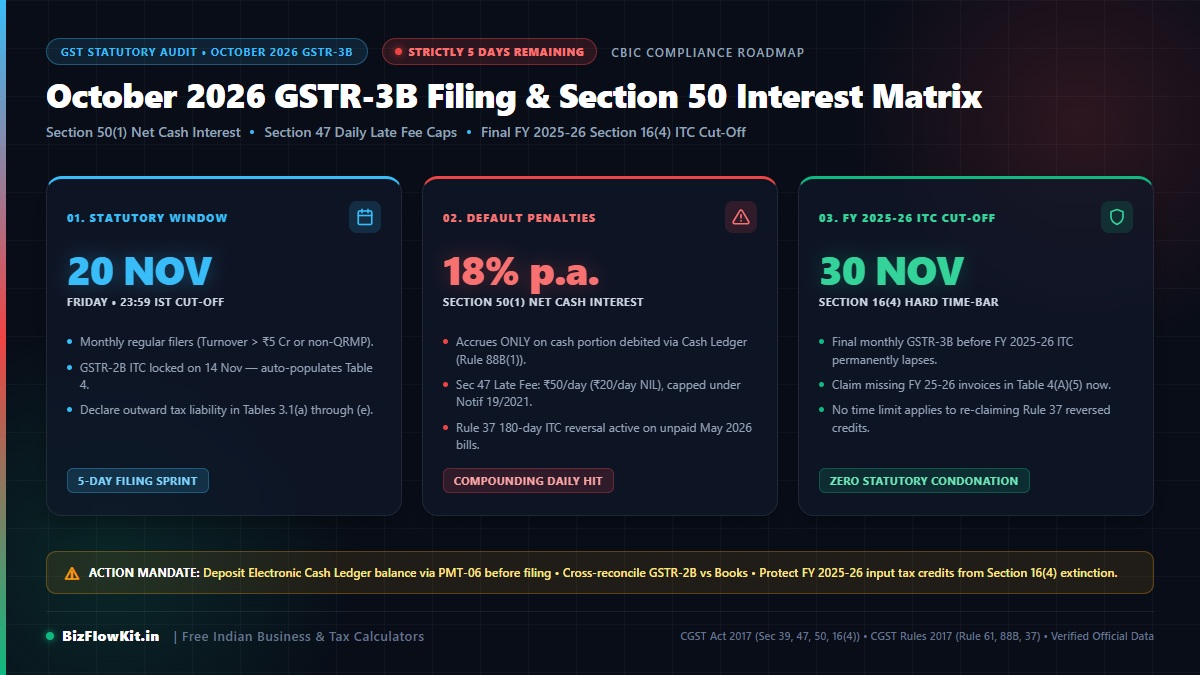
Strictly 5 Days Remaining Until Cut-Off
Executive Summary: October 2026 GSTR-3B Deadline (20 November 2026)
Under Section 39(1) of the CGST Act, 2017 read with Rule 61(1) of the CGST Rules, the statutory due date for filing Form GSTR-3B for the tax period of October 2026 is Friday, 20 November 2026 for all monthly registered taxpayers with aggregate turnover exceeding ₹5 Crores, or those who have opted out of the QRMP scheme.
The October 2026 return is the single most critical GST filing of the year: it serves as the final practical window before the Section 16(4) annual time-bar (30 November 2026) permanently extinguishes unclaimed FY 2025-26 Input Tax Credit (ITC). Furthermore, missing 20 November triggers daily compounding Section 50(1) interest at 18% per annum on net cash tax liability, automatic Section 47 late fees, and mandatory Rule 37 180-day ITC reversals on May 2026 supplier bills.
1. Statutory Framework: Who Must File GSTR-3B by 20 November 2026?
Form GSTR-3B is a monthly summary return where taxpayers report outward supplies, declare inter-State supplies, claim eligible Input Tax Credit (ITC), record reversals, and discharge their net tax liability through cash or credit ledgers.
The 20 November 2026 deadline strictly binds:
- Large Taxpayers (Turnover > ₹5 Crores): All registered entities whose aggregate turnover in the preceding financial year exceeded ₹5 Crores. These businesses are legally ineligible for QRMP and must file on a monthly cadence.
- Monthly Regular Taxpayers (Turnover ≤ ₹5 Crores): Any taxpayer who voluntarily opted out of the Quarterly Return Monthly Payment (QRMP) scheme to maintain faster ITC flow for enterprise B2B customers.
- Note for QRMP Filers: Taxpayers enrolled under the QRMP scheme for Quarter 3 (October–December 2026) are not required to file GSTR-3B on 20 November. However, they must deposit their monthly tax for October 2026 via Challan PMT-06 by 25 November 2026 (using either the 35% Fixed Sum Method or Self-Assessment Method).
Statutory Coincidence: The November Dual Deadline Crunch
Finance teams face an unprecedented double deadline: October GSTR-3B is due on Friday, 20 November, immediately followed by the extended Corporate & Tax Audit ITR Deadline on Saturday, 21 November 2026 under CBDT Circular No. 07/2026. For complete guidance on avoiding Section 234A interest and Section 80 loss forfeiture, read our companion analysis on the Corporate & Tax Audit ITR Deadline AY 2026-27.
2. Section 50(1) Interest: Rule 88B Net Cash Mechanics
When GSTR-3B is furnished after the prescribed due date, compensatory interest is levied under Section 50(1) of the CGST Act at the statutory rate of 18% per annum.
Following the landmark retrospective amendment to Section 50(1) and the insertion of Rule 88B(1) of the CGST Rules, interest on delayed returns is charged strictly on the net tax paid in cash by debiting the Electronic Cash Ledger, provided the return is filed before any formal recovery notice under Section 73 or 74.
Rule 88B(1) Mandated
Critical Computational Rules:
- Commencement Date: The interest clock starts on the day immediately following the due date (i.e. 21 November 2026) and runs through the date of return filing.
- ITC Portion Immunity: Tax discharged by debiting the Electronic Credit Ledger (ITC) is legally exempt from Section 50(1) interest.
- Day-Wise Precision: Unlike Income Tax Section 234A which charges full monthly increments, GST Section 50 interest is calculated strictly on exact elapsed days. For step-by-step mathematical proofs, consult our GST Interest Practical Walkthrough.
Worked Example: Delay in Filing October GSTR-3B
Consider Zenith Technologies Pvt Ltd:
- Total Outward Tax Liability for October 2026: ₹12,00,000 (IGST)
- Eligible Input Tax Credit in Electronic Credit Ledger: ₹8,00,000
- Net Cash Tax Payable via Electronic Cash Ledger: ₹4,00,000
- Actual Date of Filing: 30 November 2026 (Delay of 10 days: 21 Nov to 30 Nov)
The statutory calculation under Section 50(1) read with Rule 88B(1) is:
Section 47 Late Fee (10 days × ₹50) = ₹500
Total Statutory Penalty Outflow = ₹2,473
The “Cash in Ledger” Legal Trap
Depositing money into your Electronic Cash Ledger via Challan PMT-06 on or before 20 November does not legally stop the Section 50 interest clock. Until the taxpayer clicks “Offset Liability” and files the GSTR-3B return, funds in the cash ledger remain government deposits, not tax payments. You must execute return filing to complete the statutory discharge.
3. Section 47 Late Fees: Turnover Slabs & Statutory Caps
Under Section 47 of the CGST Act, every taxpayer who fails to furnish GSTR-3B by the due date is liable to pay a late fee for every day during which the failure continues.
The standard statutory rate is ₹50 per day (₹25 CGST + ₹25 SGST) for tax liability returns, and ₹20 per day (₹10 CGST + ₹10 SGST) for NIL returns. However, the government has capped maximum late fees based on annual turnover under Notification No. 19/2021-Central Tax:
4. Section 16(4) ITC Guillotine: The Final 15-Day Window for FY 2025-26
Under Section 16(4) of the CGST Act, 2017 (as amended by Finance Act 2022), the absolute cut-off date to claim Input Tax Credit in respect of any invoice or debit note pertaining to Financial Year 2025-26 is 30 November 2026.
Because GSTR-3B for October 2026 is the final scheduled monthly return before 30 November, taxpayers must use this filing to ingest all missing vendor invoices from FY 2025-26.
Irrevocable Loss: Section 16(4) Cannot Be Condoned
The Supreme Court and High Courts have consistently ruled that Section 16(4) is a non-negotiable statutory restriction, not a mere procedural timeline. If a supplier uploaded an invoice for FY 2025-26 in GSTR-1, but your company failed to claim it in GSTR-3B by 30 November 2026, the credit lapses permanently to P&L. GST authorities issue automated DRC-01 notices for any FY 2025-26 credits availed after this date.
5. Rule 37 180-Day Reversal: May 2026 Invoices Expiring in November
Under the second proviso to Section 16(2) read with Rule 37 of the CGST Rules, if a recipient fails to pay the supplier the invoice value along with tax within 180 days from the invoice date, the corresponding ITC availed must be reversed in Table 4(B)(2) of Form GSTR-3B.
- Invoices Crossing 180 Days: Inward invoices issued between 1 May 2026 and 31 May 2026 reach their 180-day aging limit in November 2026. If payment has not been remitted, this ITC must be reported under Table 4(B)(2).
- 18% Interest Liability: Reversal under Rule 37 attracts 18% per annum interest from the date the credit was originally availed until the date of reversal.
- Re-Availment Without Time Limit: Crucially, Rule 37 reversals are not subject to the Section 16(4) time-bar! When payment is finally made to the supplier in a subsequent month, the assessee can lawfully re-avail the credit in Table 4(A)(5) without any expiry. Read our full analysis in the Rule 37 ITC Reversal & Re-Availment Guide.
6. Practical Taxpayer Scenarios: On-Time vs. Belated Filing
Review the four real-world compliance profiles below to quantify the direct financial impact of timely vs. delayed October GSTR-3B filing:
7. 5-Day Action Checklist: Operational Timeline (15–20 November 2026)
Execute this structured checklist to ensure zero-error October GSTR-3B submission ahead of the portal rush:
Frequently Asked Questions (FAQ)
1. If my entire tax liability is paid using ITC, do I have to pay Section 50 interest if I file late?
No. Under Section 50(1) read with Rule 88B(1) of the CGST Rules, interest on belated return filing is calculated strictly on the tax paid by debiting the Electronic Cash Ledger. If your net cash tax is ₹0, your Section 50 interest is ₹0. However, you will still be liable to pay statutory late fees under Section 47 (up to ₹50 per day of delay).
2. Can I claim missing FY 2025-26 ITC in my November GSTR-3B filed in December 2026?
No. Section 16(4) of the CGST Act prescribes 30 November 2026 as the absolute cut-off. Any GSTR-3B filed after 30 November cannot claim ITC for invoices or debit notes pertaining to FY 2025-26. The GST portal automatically blocks and flags such credits, resulting in automated scrutiny notices.
3. Does Rule 37 ITC reversal apply if payment is delayed due to vendor disputes?
Yes. The second proviso to Section 16(2) does not make any exceptions for commercial disputes, retention money, or quality holds. If the supplier is not paid within 180 days from the invoice date, the ITC must be reversed along with 18% interest. You can re-avail the credit immediately upon settlement and payment without any time restriction.
4. Are late fees applicable to NIL GSTR-3B returns?
Yes. Filing a NIL return late incurs a fee of ₹20 per day (₹10 CGST + ₹10 SGST), capped at a maximum of ₹500 (₹250 CGST + ₹250 SGST) under Notification No. 19/2021-Central Tax.
5. What should I do if my supplier uploaded the invoice with the wrong GSTIN?
If an invoice does not reflect in your GSTR-2B due to an erroneous GSTIN, you cannot claim ITC for FY 2025-26 after 30 November. Instruct the supplier to rectify the invoice in their October 2026 GSTR-1 or file an amendment immediately before the 30 November deadline passes.